IDM researcher wins prestigious award - Women in Science Awards 2015

PhD student Khanyisile Kgoadi, of the Institute of Infectious Disease and Molecular Medicine (IDM) received the prestigious Tata Scholarship, at the Women in Science Awards 2015 last week Thursday. The Women in Science Awards (WISA) 2015 were founded by the Department of Science and Technology in 2003 as an intervention to reward and recognise women in the sciences.
WISA 2015 chose the theme 'Science for a sustainable future'. The theme is based on the Millennium Development Goals (MDG), which had a deadline of 2015, and are now superseded by the Sustainable Development Goals (SDG). These goals set out a number of objectives, including addressing extreme poverty and ensuring basic human rights in health, education, shelter and security.
Below is a feature on Miss Kgoadi taken from an article profiling the three UCT researchers who won WISA awards this year.
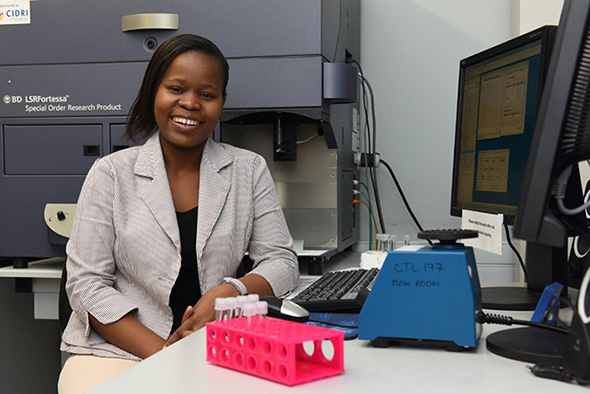
Khanyisile Kgoadi
Central nervous system tuberculosis (CNS-TB) is the deadliest form of TB, with mortality rates as high as one in two. However, we do not yet understand the host immune mechanisms needed to protect against it. We therefore urgently need researchers to generate new knowledge and increase the depth of scientific insight into this area.
PhD student Khanyisile Kgoadi is one such researcher, and is currently investigating mechanisms associated with dendritic cell-T cell interaction during (CNS-TB). CNS-TB is an inflammation disease and many cell types play an important role in the immune defense responsible for clearing of the inflammation. Dendritic cells seem to be potential key players in understanding the mechanisms that occur in CNS-TB because of their characteristics and ability to initiate innate immunity, activate and alter T-cell responses in clearing the inflammation.
Before embarking on her PhD, Kgoadi had already made her mark during her honours and master's degrees, where she studied under a renowned leader in the field of HIV/AIDS, Professor Debra Meyer, at the University of Pretoria. Here she was one of a few researchers in the world addressing HIV/AIDS and highly active antiretroviral therapy (HAART) using novel-based metabolic approaches.
Dr Aurelia Williams, postdoctoral fellow at the University of California, San Francisco, who was her mentor and honours co-supervisor and who nominated her for the award, said she was impressed by her dedication to "making a change in the lives of people infected and affected by poverty-related diseases".
Said Kgoadi: "I chose to go into this field because I could not bear the heartache and despair I feel when I see and hear of people who are suffering from HIV/AIDS. Science offered me an opportunity to make a difference, so I took it."
She moved into the field of TB research because of the high rates of co-infection. "To tackle both of these infections, which are still so high in South Africa and Africa, I need to research both," she said.
Her current supervisor, Associate Professor Muazzam Jacobs, predicts a stellar trajectory for her. "I have had many postgraduate students passing through my hands; Khanyisile Kgoadi is among those I expect, and will accept nothing less than, performing at a scientific level equal to the best."
She has already notched up a first-author publication and won several competitive awards; at the same time, she has engaged in a number of community outreach initiatives.
"I love working with the people, for the people," said Kgoadi.
Adapted from UCT News article "UCT's women scientists make their mark in Africa" which showcases all UCT WISA 2015 winners.
Compiled by Carolyn Newton. Photos by Michael Hammond. Video of Dr Gina Ziervogel courtesy of the Department of Science & Technology (DST).