The Student Curriculum Lekgotla is multinational network of health professions students and young trainees engaged in the work of curriculum transformation that is convened out of the University of Cape Town's Faculty of Health Sciences.
Upcoming Events
The Student Curriculum Lekgotla invites students, educators, and partners across South Africa to its Inaugural Symposium on 2 May 2026 at the University of Cape Town.
Under the theme “The Role of Students in Curriculum Change,” the symposium will showcase student-led work emerging from the Lekgotla network. Presentations will explore key areas of health professions education including vertical integration, interprofessional learning, and innovative approaches to assessment design.
The programme will feature student presentations followed by a panel discussion and a brief co-creation session, creating space for dialogue between students, educators, and institutions committed to strengthening health professions education.
This symposium marks an important step in building a continental community of students actively engaged in shaping the future of health professions education.
Frances Ames Room, Barnard Fuller Building, UCT
Saturday, 2 May 2026
09:30 – 14:00
Open
RSVP for the Symposium
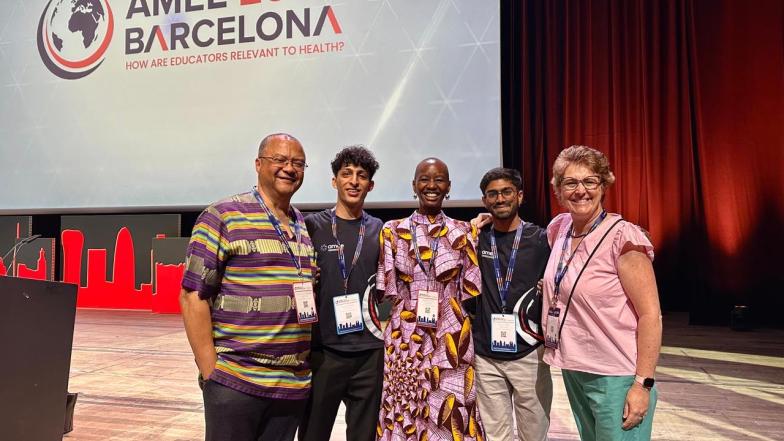
The Student Curriculum Lekgotla (SCL) at the University of Cape Town was awarded the 2025 Patil Innovation Award at the AMEE International Conference in Barcelona, one of the most prestigious global forums in health professions education. Selected from 72 international submissions, the SCL was recognised for its innovative, student–staff partnership model grounded in African dialogic traditions of the lekgotla, advancing structured, values-driven, and justice-oriented curriculum transformation. Convened in 2023 within UCT’s Faculty of Health Sciences, the initiative remains in its formative phase, with the award acknowledging the vision, groundwork, and collaborative leadership of students and faculty who have shaped its foundations. This recognition positions UCT at the forefront of a growing global shift—from consultation to co-construction—affirming that African-rooted innovation from the Global South can meaningfully set the agenda for the future of health professions education worldwide.
Open
Who We Are
Founded in 2023, the Student Curriculum Lekgotla (SCL) creates a structured space for sustained student–staff engagement on curriculum design, delivery, and assessment across the health sciences at the University of Cape Town. The term lekgotla is drawn from Southern African traditions of collective deliberation, referring to a communal forum where dialogue, listening, and consensus-building guide decision-making. In adopting this term, the SCL signals both method and ethos: a commitment to relational engagement, shared responsibility, and principled disagreement held within care. Convened and co-chaired by fifth-year MBChB students Danika Govender and Sayuran Pillay with the UCT node managed by Sarah Philander, the SCL emerged in response to fragmented and inconsistent student involvement in curriculum change processes within the Faculty. It operationalises the lekgotla not symbolically, but practically—through structured dialogue, iterative feedback cycles, and accountable partnership with educators—reframing students as legitimate co-constructors of knowledge. Grounded in decolonial scholarship and intentional Africanisation, the SCL moves beyond additive inclusion toward re-centering African ways of knowing, relating, and learning, advancing health professions education that is academically rigorous, socially responsive, and contextually grounded.
Why the Student Curriculum Lekgotla Exists
Health sciences curricula are technically demanding and professionally regulated, yet students’ lived experiences of learning are often engaged through once-off or fragmented feedback processes that are poorly equipped to inform sustained curriculum development. These limitations are most visible across transitions into clinical practice, interprofessional learning environments, and diverse health system contexts, where insight is generated continuously but rarely held coherently over time.
The Student Curriculum Lekgotla was established to respond to this gap by embedding structured, ongoing student–staff partnership within curriculum reflection and renewal. Informed by critical pedagogical scholarship—particularly Paulo Freire’s conception of education as dialogic, relational, and co-constructed—and by Southern African traditions of collective deliberation reflected in the lekgotla, the SCL approaches curriculum as a living practice rather than a fixed product. This orientation reflects an intentional Africanisation of curriculum work: moving beyond additive inclusion toward re-centring dialogue, relational accountability, and shared responsibility for knowledge-making.
Within this framework, the SCL is designed to:
enable ongoing, structured student participation across all years of study, ensuring continuity of insight across stages of professional formation;
support reflective, dialogic engagement between students and educators, where difference and disagreement are held productively rather than collapsed into consultation;
strengthen alignment between curricular intentions and learning realities, particularly within interprofessional and clinically embedded training contexts; and
contribute constructively to educational quality and transformation through synthesised, ethically grounded input routed via accountable governance structures.
The SCL operates as an interprofessional and inter-institutional network of health professions trainees, with representation across medicine, nursing, rehabilitation sciences, and allied health disciplines. Students from each year level contribute perspectives that are brought into structured forums focused on specific dimensions of the curriculum. These insights are synthesised and fed into higher-level curriculum conversations with senior conveners and faculty leadership, while graduate perspectives ground reflection in transition-to-practice realities. Through parallel engagement across multiple institutions, the SCL functions as a Global South knowledge network, enabling contextual learning and responsible translation of insight into local curriculum reform.
Relationship with Faculty Structures
The Student Curriculum Lekgotla does not replace or duplicate existing faculty governance structures.
Instead, it:
Complements formal curriculum committees and review processes
Provides a coordinated channel for student perspectives
Works in collaboration with departments, educators, and faculty leadership
Engages alongside recognised student governance structures, including the Health Sciences Student Council (HSSC)
Who Is Involved
The SCL brings together:
A student leadership and coordination team
Working groups organised by year level or thematic focus
Engagement with class representatives and student cohorts
Faculty partners and advisors (as appropriate)
Participation is guided by agreed terms of reference and a commitment to constructive, good-faith engagement.
Staff Partnership
The Student Curriculum Lekgotla operationalises the scholarship of students as partners—a field largely developed in the Global North that emphasises reciprocity, trust, and co-creation in teaching and learning—while re-grounding it in Global South contexts where partnership must explicitly engage power, history, and epistemic inequality. This work has been enabled through sustained staff partnership with Dr Dina-Ruth Lulua, Professor Lionel Green-Thompson, Dr Morne Visser, and Dr Jaisubash Jayakumar (Chair, Staff Advisory Committee). Together, these partnerships enact a model of relational accountability and epistemic justice, enabling students to move beyond participation toward responsible co-construction of curricula that is pedagogically sound, contextually grounded, and ethically sustainable. In doing so, the SCL contributes an African articulation of student–staff partnership that does not merely adopt global frameworks, but actively reshapes them.
Do you want to get involved?
If you are a staff member and keen to contribute, a student or recent graduate who wishes to contribute to curriculum change or set up an SCL node at your institution or if you would just like to join our mailing group to be kept in the loop about our development, shared global events and capacity building programs please contact sclexco-group@myuct.ac.za
Open