Undergraduates visit Hanover Park community in social responsiveness initiative
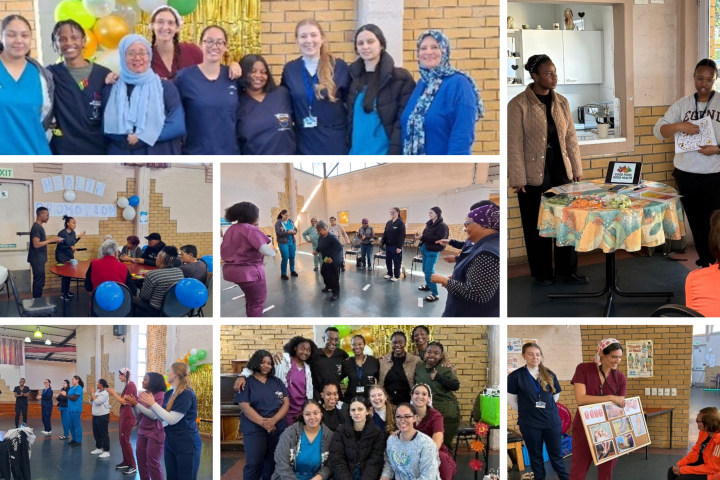
4th year MBCHB HIC students; 3rd year Physiotherapy & Disability students with Mrs Fahmida Harris and Mrs Baheya Najaar during a health promotion initiative at F.G Lowe Village in Hanover Park.
Interprofessional learning (IPL) is learning that arises from the interaction between members of two or more professions and may develop through interprofessional education (IPE) or during interactions in educational or clinical practice settings1.
Interprofessional education (IPE) has been recognised for its benefits in healthcare education and practice by enhancing collaboration, communication and teamwork among health professions education students2,3,4. The aim is for health professionals from diverse fields to work together to deliver comprehensive services, ensuring the delivery of the highest quality of care to patients, their families, carers, and communities5. According to the World Health Organisation (WHO), IPE “occurs when students from two or more professions learn about, from, and with each other”6 to develop skills that are essential for interprofessional collaborative practice.
Health Promotion (HP) Activity
The health promotion activity was supervised by Mrs Baheya Najaar (Site Facilitator for Department of Family, Community Emergency Care, UCT) and Mrs Fahmida Harris (Snr. Clinical Educator from the Division of Physiotherapy, DHRS, UCT). Students from 4th year MBCHB Health in Context (HIC) course; Division of Physiotherapy and Disability Studies contributed to the health promotion initiative at F.G Lowe Village in Hanover Park. Participation of residents was voluntary and included older persons from the independent living and frail care centres.
The aim of the HP activity was to promote health amongst older persons by educating on co-morbidities such as diabetes and hypertension. Developed and presented by MBCHB students, the HP activity was modelled on the amazing race but tailored for older persons. Consisting of four stations; with core messages and activities focusing on behavioural determinants of health i.e. nutrition guidelines, foot care, physical activity, self-medication and its benefits were highlighted for the residents.
To celebrate World Physiotherapy Day, physiotherapy students emphasized theme principles of healthy ageing and falls prevention, providing much needed physical activity that was enjoyed by all.
In line with the WHO definition of active ageing, participants were allowed to practice autonomy and independence in identifying their own health needs and were empowered to be accountable and take responsibility for their own health.
Social responsiveness refers to duty of organisations and individuals to respond to social needs and contribute positively to the welfare of their communities. Community participation is notably a core principle of health promotion activities within the health sciences faculty and plays a significant role in transformation.
Students and residents collectively participated in planning the programme for the day providing agency to this group of retired individuals. Elated FG Lowe residents were also gifted with lunch and goodie bags as a gesture to say thank you for their participation. They reported enjoyed learning experiences in a “relaxed and fun environment”.
Physiotherapy students provided valuable feedback:
“Working with the med students was very beneficial and insightful. We decided to include the FG Lowe residents in the planning of the programme/event to get an idea of what they actually feel like they really need to gain more knowledge and education on. This helped shape some goals for us students and lead the planning in a more effective direction”
“This was a very fun and exciting programme to be part of. I really enjoyed working together with different disciplines and seeing how they apply their clinical skills and interact/manage certain health conditions that physios also play a role in”
The well-being of health professionals often hinges on their ability to work together seamlessly4 and many studies have highlighted these benefits, emphasising shared goals and a person-centred approach to care7,8,9. This approach improves access to health interventions, supports coordination and enhances involvement in decision-making10. The approach also strengthens health systems, making them more resilient, comprehensive, and responsive to population needs11.
This cultural shift towards collaboration starts in educational institutions where students from various health professions learn together, fostering mutual respect and understanding. This culture, nurtured through IPE, is essential for transforming healthcare settings into places where teamwork is the norm, not the exception4.
References
1. Freeth D, Hammick M, Reeves S, Koppel I, Barr H. Effective Interprofessional Education: Development, Delivery and Evaluation. Oxford: Blackwell Publishing Ltd; 2005
2. Choudhury RI, Salam MAU, Mathur J, Choudhury SR. How interprofessional education could benefit the future of healthcare – medical students’ perspective. BMC Med Educ. 2020; 20:242
3. Dyess AL, Brown JS, Brown ND, Flautt KM, Barnes LJ. Impact of interprofessional education on students of the health professions: a systematic review. J Educ Eval Health Prof. 2019; 16:33
4. Patel & Perry. A scoping review of interprofessional education in healthcare: evaluating competency development, educational outcomes and challenges. BMC Medical Education. 2025, volume 25, Article number: 409
5. van Diggele C, Roberts C, Burgess A, Mellis C. Interprofessional education: tips for design and implementation. BMC Med Educ. 2020; 20:1–6.
6. World Health Organization. Framework for action on interprofessional education and collaborative practice. Geneva: World Health Organization; 2010.
7. Razai MS, Kooner P, Majeed A. strategies and interventions to improve healthcare professionals’ well-being and reduce burnout. J Prim Care Commun Health. 2023; Jan-Dec;14: 21501319231178640.
8. Cohen C, Pignata S, Bezak E, Tie M, Childs J. Workplace interventions to improve well-being and reduce burnout for nurses, physicians and allied healthcare professionals: a systematic review. BMJ Open. 2023;13(6): e071203.
9. Zechariah S, Ansa BE, Johnson SW, Gates AM, Leo G. Interprofessional education and collaboration in healthcare: an exploratory study of the perspectives of medical students in the United States. Healthcare (Basel). 2019;7(4):117.
10. Gilbert JHV, Yan J, Hoffman SJ. A WHO report: framework for action on interprofessional education and collaborative practice. J Allied Health. 2010;39(Suppl 1):196–7.
11. Rosewilliam S, Indramohan V, Breakwell R, Skelton J. Learning to be patient-centred healthcare professionals: how does it happen at university and on clinical placements? A multiple focus group study. MedEdPublish. 2016;2020(9):53.