New Powerlab for Department of Human Biology
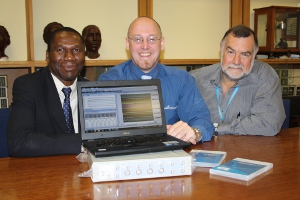
Dr Peter Parslow, the general manager of the international division of the company providing the grant, explained that the award is open to researchers across the world, and this is one of only four grants that have been awarded worldwide. The Early Research Career Grant affords recipients the opportunity to build their research equipment by offering state of the art electronic measuring equipment that can be used for both research and teaching purposes.
In thanking Dr Parslow for the grant, Dr Gwanyanya said that "Here in Africa, if you support one, you support many." He went on to explain that just as he had made use of colleagues' equipment from time to time, the donors of the Powerlab could be assured that colleagues in the department and their collaborators, could share the use of the equipment, maximizing the technological opportunity being made available to them.
Head of the Department of Human Biology, Assoc. Professor Laurie Kellaway added his thanks, and assured Dr Parslow that the department also sees the Powerlab "as a great teaching tool, with a lot of potential for the Faculty."
Born in Zimbabwe, Dr Gwanyanya is a specialist anaesthetist graduate of the University of Zimbabwe, and has a PhD from the University of Leuven in Belgium. He joined UCT as a senior lecturer two years ago and has since established a new research project focussing on the mechanisms of heart enlargement disease, a process called hypertrophy.
He explained that his research interest in heart diseases was triggered by his clinical experiences as an anaesthetist working with critically ill patients who needed heart and lung support.
"Heart diseases remain the greatest killer worldwide, including Sub-Saharan Africa and this problem is on the increase, making it imperative that medical solutions be found to treat these diseases," he said. At present, Dr Gwanyanya collaborates with Dr Roisin Kelly and Dr Elizabeth van der Merwe within the Department of Human Biology as well as with Prof Kanigula Mubagwa of the University of Leuven.
The Powerlab system has many biological applications and in this instance will be used to study the electrical and pumping activities of the enlarged heart. It is also able to record the mechanical actions of other organs, such as the lungs and the electrical activities of the brain, creating scope for collaborations across the Faculty of Health Sciences.