
13th Annual School of Public Health Research Day
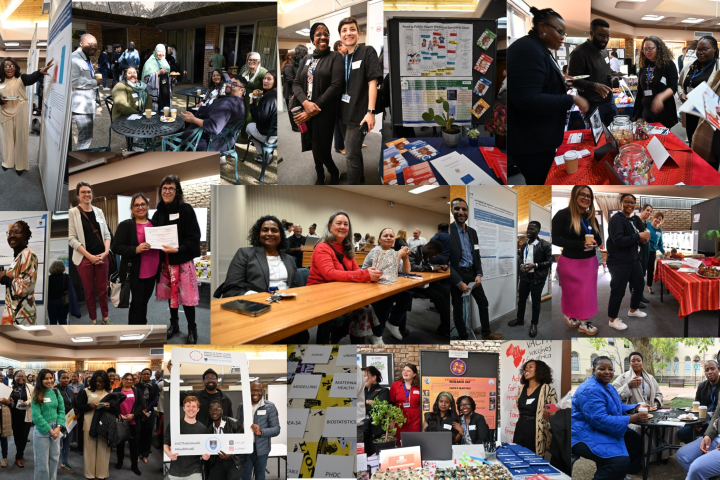
A sunny yet windy spring morning brought a buzz of excitement at the UCT health sciences campus as the students took centre stage at this year’s School of Public Health (SPH) Research Day.
Themed ‘Innovation, Adaptability and Sustainability in a Changing World’, this event, held on 18 September 2025, was an opportunity to celebrate innovation, inquiry, and academic excellence among students and the 11 SPH academic divisions and research centres.
An exhibition of 26 student posters was presented at the France Ames conference room in the Barnard Fuller building, while breakfast was served alongside hot beverages from The Coffee Hustler in the courtyard.
The posters showcased the diverse research being conducted across degree programs and divisions in the school, reflecting on research creativity, critical thinking, and a commitment to advancing knowledge and advancing impact.
Students presented research on a wide range of topics, including infectious diseases, maternal and child health, vaccines, substance use, environmental and occupational health, non-communicable diseases, cancer, injuries, policy reform and health systems strengthening.
Engagement was high, with students fielding questions from staff and peers, and expressing enthusiasm about translating their research into practice. Students got a taste of what to expect when presenting their research outputs at conferences beyond the safety net of the university, so to speak.
All posters can be viewed on the SPH DRC webpage, and some are displayed on Level 1 of Falmouth Building. Poster prizes were awarded as follows based on formal scientific judging and popular vote:
Top poster award: PhD student Feroza Amien - General and Oral Health Advocacy: Perspectives of South African Medical Practitioners and Educators.
- First runner-up: MPH student Kimeshnee Govindsamy - Missed opportunities in cervical cancer prevention for adolescent girls and young women living with HIV: A global assessment of integrated care models.
- Second runner-up: MBChB student Katleho Marake - How green is Heineken?.
Honourable mentions:
- MSc Epi & Biostats student Mpumelelo Zondo - The epidemiology of acute and traumatic hand injuries by power tools at a tertiary hospital in South Africa.
- MPhil student Maxine de Araujo - Screening and prevalence of maternal syphilis in a rural and urban community in the Western Cape, South Africa.
- MPhil student Jodilee Erasmus - Community health in the shadow of policing and substance use, Cape Town.
- MPH student Shannal Pillay - Describing postpartum location of maternal ART and infant HIV testing in Gugulethu, South Africa.
- MPH student Kelechi Nnene - Shifting the cost curve: economic benefits of early-stage colon cancer presentation in a South African tertiary hospital.
Popular vote awards:
- Most visually appealing poster: Esther Opone (MPH) - Safeguarding the digital generation: Qualitative analysis of Africa-based digital technology companies’ policies impacting African youth health and well-being.
- Most engaging presenter: Tazkia Abram (MBChB) - Policy dystopia: Analysing government discourse in defence of South Africa’s Tobacco Control Bill during a public engagement exercise.
The student poster session was followed by the Research Fair, where the various divisions, research centres and committees showcased their work through displays, games, shared resources, and treats.
The popular vote for the most inspiring stall was taken byVaccines for Africa (VACFA), followed by Division of Epidemiology and Biostatistics, mirroring last year’s results.
The morning also featured Research Day Bingo, designed to encourage networking and conversations across divisions. A lucky draw for completed Bingo cards was held for participants, adding a fun and interactive element to the day. Paula Saner, from the UCT Office of Research Integrity, won the lucky draw.
After lunch, the Research Symposium took place at the New Learning Centre Lecture Theatre in the Anatomy Building.
The SPH Head of Department Professor Susan Cleary opened the session and thanked the members of the Department Research Committee (DRC) for putting together this annual event.
This was followed by the DRC Chairperson Dr Tammy Phillips introducing the PhD/Postdoc showcase which was co-chaired by Dr Tsepiso Mbangiwa (postdoctoral fellow) and Mr Mustafa Shuaib (PhD student). The presentations (listed below) highlighted the range of disciplines and stakeholders involved public health research. Students underscored the importance of innovative and inclusive research methods and innovations for health promotion and health systems resilience.
PhD/Postdoc showcase presentations
SPH Division | Presenters | Presentation title |
Health Policy and Systems | Nothemba Kula | Strengthening Everyday health Systems Resilience in SA: What lessons can we learn from the TB program? |
Health Economics | Mina Haji | Beyond the Binary: Mental Health and Well-being of Transgender and Gender-Diverse Adults in South Africa |
Public Health Medicine | Neil Hassan | Harmful alcohol use in Southern Africa: Exploring how |
Environmental Health | Wisdom Basera | Reproductive health and developmental effects due to environmental pesticide exposure amongst boys in the rural Western Cape in South Africa |
Vaccines for Africa | Penka Marthe Bogne | Innovative Health Communication: Storytelling for Immunization |
Social and Behavioural Sciences | Prudence Muusha-Kandi | Exploring cervical cancer screening among female sex workers in Cape Town |
Occupational Medicine | Itumeleng Ntabalala | Using CO₂ research to reimagine health & safety in indoor environments |
Plenary lecture
Dr Phillips then introduced the Head of the Environmental Health Division, Professor Andrea Rother, who delivered the plenary lecture entitled: ‘The role of risk communication in innovation, adaptability and sustainability – the case of environmental health and chemicals’.
Prof Rother discussed the importance of risk communication in managing exposure to household pesticides, emphasising the need for interactive, audience-tailored, and culturally relevant information.
She highlighted the high exposure to pesticides in South Africa, noting that cumulative exposure to multiple chemicals is common.
She criticised misleading advertising and marketing strategies used in some of the well-known and widely used household pesticides, which are presented as harmless and even beneficial to the user.
She stressed the need for clear, accessible information about the toxicity of pesticides, including the use of colour codes for toxicity levels.
Prof Rother also mentioned ongoing efforts to update the outdated legislation to better regulate pesticide use and communication.
Debate: Is AI in public health research a game changer or a mine field?
The plenary lecture was followed by another long-awaited session – the debate on artificial intelligence (AI), moderated by Dr Edina Amponsah-Dacosta.
As the debate got underway, Dr Amponsah-Dacosta encouraged attendees in the room and online to vote whether they were for or against AI’s use in public health research. Many votes in the room were for the use of AI. Now the figurative gloves were on and the debate ensued.
Debaters for AI were Acting Head and Director for the Health Economics Unit and Division Dr Lucy Cunnama and Research Integrity Manager from the UCT Office of Research Integrity, Ms Paula Saner.
In the opposing corner, making arguments against AI were Senior lecturer in the Division of Epidemiology and Biostatistics Dr Alex De Voux and Vaccines for Africa (VACFA) Co-Director Dr Benjamin Kagina.
The debate on AI in public health research revealed mixed opinions. Proponents argued AI's potential in accuracy, consistency, and efficiency, citing examples like pathology and disease surveillance. Opponents, on the other hand, raised concerns about environmental impact, equity, and the displacement of human expertise. Opponents also argued that at present, AI does not make use of Afrocentric data sources that are representative of the local context. And in an unexpected turn of events at the end of the debate, the audience was swayed and majority voted that AI is a minefield. The closing message was one a call for caution and transparency, AI can be a gamechanger for public health research, but we must be cautious of and responsive to the potential minefields.
The Research Symposium concluded with closing remarks from the DRC Co-Chair, Dr. Patience Nyakato. In her address, she emphasized that the spirit of shared responsibility is reflected in innovation, adaptability, and sustainability in action. She noted that collaboration and collective effort are essential for thriving in a changing world.
Those who would like to provide feedback and ideas for Research Day 2026, please complete the evaluation. The form will be open until Friday 17 October.

Article compiled by: Buhle Ndweni, Meryl Jagarnath, Luyanduthando Mqadi and Tammy Phillips.