
UCT Collaborative Educational Practice Award to A/Prof Andrea Rother

Associate Professor Andrea Rother, group leader for the Post Graduate Diploma in Pesticide Risk Management (DPRM) project, along with her collaborators Gregory Doyle (Education Development Unit) and Shanali Govender (Centre for Innovation in Learning & Teaching) have received UCT's award for Collaborative Education Practice (CEP).
The aim of the award was to recognize and promote collaborative approaches to enhance the teaching and learning environment at UCT.
Five years ago when DPRM was first introduced to provide professionals with skills to be a comprehensive and effective pesticide risk manager, the approach and how the course was offered were cutting edge. The programme is structured around the United Nations Food and Agricultural Organization's (FAO) Code of Conduct on Pesticide Management. Students are from low and middle income countries (LMIC) such as South Africa, Zimbabwe, Mozambique, Zambia, Botswana, Namibia, Kenya, Tanzania, Malawi, Swaziland, Lesotho, Eritrea, Nigeria, Serra Leone, Uganda, Figi, St Lucia, Samoa, and Guyana.
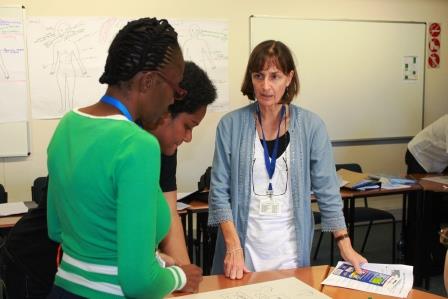
Andrea Rother (far right) with DPRM students
One challenge addressed was how to build a community of practice on-line for students. The result has been an innovative approach of a virtual seminar run as a discussion forum through the students’ Vula site chat room. This real time bi-monthly discussion has 364 members including students and global experts debating and discussing current pesticide risk management challenges.This discussion forum utilizes blogs, emails. Skype and What's App to support working students with connectivity issues to participate. The outcome of the discussion is a newsletter circulated wider than to just members.
The Writing Centre and the Centre for Innovation in Learning & Teaching, through Shanali Govender, have been actively involved from the beginning and tailored their teaching programmes to the needs of the DPRM students and distance learning. Students receive regular support for producing policy briefs and other documents, while back at home which has enhanced the quality of their work.
The criteria for the CEP award were:
1. The project exploits the synergies arising out of collaboration to address a challenge that has arisen in the teaching and learning environment.
2. The project has effectively addressed the challenge that the team set out to address.
3. The project involves innovation and goes beyond “business as usual”.
4. The project has been implemented for at least three years and is sustainable.
5. The project includes systems of monitoring and evaluation that feed into a continuous improvement cycle.
6. Project members draw on appropriate research literature both in the discipline and the teaching of the discipline.
7. The project has served as an example of good practice to colleagues at UCT.