
General Information, Conditions and Restrictions
Importance of Human Body Donation
The Faculty of Health Sciences at the University of Cape Town (UCT) acknowledges, with deep respect, the rare gift of whole-body donation. These bequests are vital for the teaching of anatomy to medical, physiotherapy, occupational therapy, speech therapy, audiology, and science students at all levels. Bequests are also important for training qualified professionals, e.g., surgeons, in new techniques and to conduct ethically approved research such as, but not limited to, understanding human variation, forensic science, developing medical devices, and genetic studies. It is for these reasons that the Departments and Faculties that teach and conduct research in human anatomy in South Africa are legally empowered to receive bodies.
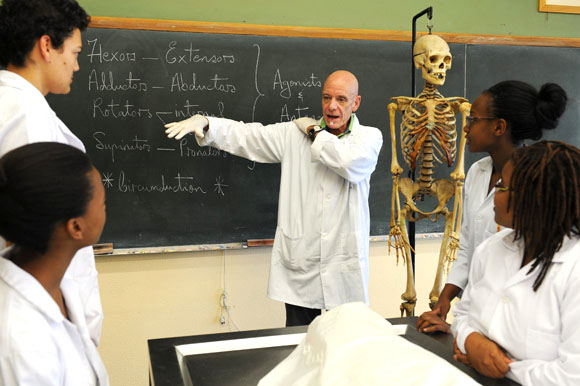
Teachers on the table: Bodies donated to UCT's anatomy laboratory for dissection by second-year medical students are a vital part of medical education, even when the donor is a centenarian - a trend that's increasing, says Professor Graham Louw. (Photo by Michael Hammond)
What are the benefits?
Contribution to the good of society through education and training of healthcare professional students, on the human body and its variation.
The potential, if of interest to you, is to also consent to your body to be used for research. Unfortunately, this research does not take the form of an autopsy and we are therefore not able to provide your next of kin with any form of postmortem report.
The Department of Human Biology will pay the expenses for transporting the donated body from the place-of-death, in the greater Cape Town area (approximately 200kms from Cape Town)., to UCT and for the costs of cremation.
If I decide to donate, what does it involve?
You need to meet the acceptance criteria and choose the kind of donor you wish to be.
Acceptance criteria
The Department endeavours to accept all bequests from the greater Cape Town area.; however, there are exclusion criteria to be assessed at the time-of-death:
- If the cause-of-death has resulted in extensive trauma to the deceased.
- If the donor has passed away outside of the greater Cape Town area. Please contact the department if you have any queries.
If a bequest is deemed unsuitable based on the criteria above, the Department will not be liable for the undertaker charges.
If your family would like your ashes to be retained, there will be a delay of approximately 24 months before this can take place. Please note that they will have to contact the Department at BodyDonor-group@uct.ac.za within 6 months of the donation to make this request. The next of kin will then be contacted when the ashes are available for collection.
Options
Once you have read the donor information and decided to agree to be a donor the following options are available to you.
- Option 1: Anatomical education including retention of tissues and samples for academic research and teaching purposes covered by Governing Committee permission. Ashes cannot be returned to the family with this option.
- Option 2. Anatomical education only, no tissue retained,
Dedication ceremony
At the end of each academic year the Department holds an annual dedication ceremony, for staff and students to honour the donors that have contributed to their education. This service is multidenominational and includes tributes from the students. family and friends of the donor are welcome to attend the service. Please contact Michael.cassar@uct.ac.za if you wish to attend this ceremony.
Cremation
If the remains are not retained, then they will be cremated and the ashes buried, without a service, at the relevant crematorium.
Ashes
If option 2 has been selected, the family may request that the ashes of the deceased be retained. Should relatives wish to receive the ashes, they should submit a written request (e-mail BodyDonor-group@uct.ac.za ) not later than 6 months after the donor has passed away. The next-of-kin will only be contacted when the ashes are available for collection. Please note that this will only happen approximately 24 months after the donor has passed away. Once the next of kin have been contacted, they are requested to collect the ashes within a period of 3 months, failing which the ashes will be buried at the crematorium.
Instructions for next-of-kin
• Contact the doctor that was treating the donor and inform them that he/she has passed away.
• If the doctor is uncontactable, the local police would need to come to the residence and leave an SAP 180. The local paramedics (Tel: 10177) would also need to come to the residence and leave a D.O.A. Once both of those forms have been left at the residence, AVBOB (021 593 8553/4) can then be contacted.
• If the doctor is contactable and is willing to issue the BI 1663, it will not be necessary to contact the above.
• Should the donor pass away at a retirement village, the sister in charge, will contact the doctor and necessary people on behalf of the family.
• AVBOB require the next of kin to provide a copy of the donation form, and a copy of the deceased’s Identity document. They will then arrange for the collection of the BI 1663, from the doctor’s rooms.
• A death certificate can only be issued by Home Affairs. The Department or AVBOB will contact the next of kin once this is ready for collection.
How do I consent?
Now that you have read the information sheet. If you wish to be a donor, please fill in the consent form. Consent can be withdrawn at any time by using the contact details below. If you choose to donate, it is suggested that donors should inform their families of their donation plans and ensure that they agree to the bequest, so that the wishes of the donor are respected posthumously. Please make sure that you keep a copy of this information sheet and a filled in form for your records as well as giving them to your next-of-kin.
Any questions?
If you have any questions with regards to human body donation, please contact Mr Michael Cassar Michael.cassar@uct.ac.za. Alternatively, contact the Department of Human Biology on 021-406 6235or email BodyDonor-group@uct.ac.za