
Creative Commons Licenses (CC) - Intellectual Property policy and OER
A Creative Commons (CC) license is a standardized way for creators to grant public permission to use their copyrighted work under specific conditions, such as attribution and non-commercial use. These licenses allow creators to easily define how their work can be used and reused, while still maintaining certain rights, and they are free for both creators to apply and the public to use.
How Creative Commons licenses work
Building on copyright: They operate within the framework of copyright law, allowing creators to grant permissions that copyright law wouldn't otherwise permit.
Standardised permissions: They provide a uniform set of licenses, making it easier for people around the world to understand how they can use a work legally.
Cost-free: Applying a CC license is free, and the use of materials under a CC license is also free, provided the terms of the specific license are followed.
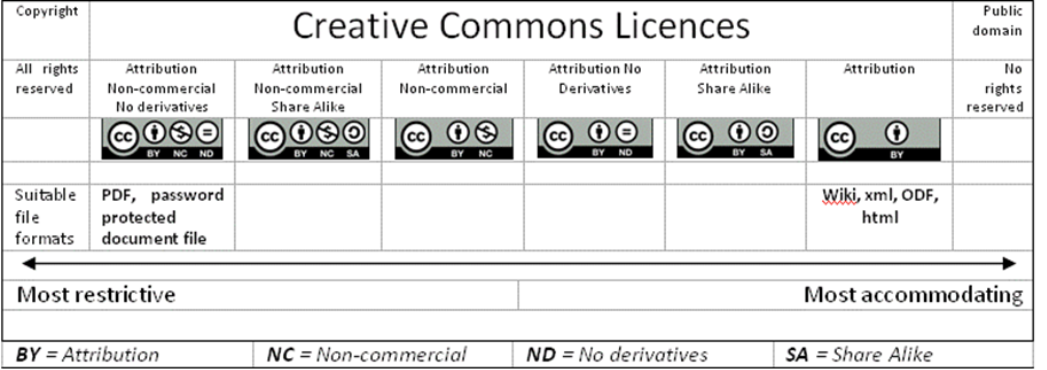
Flexibility: Different licenses offer varying degrees of permission. For example, some require attribution (CC BY), while others also prohibit commercial use (CC BY-NC) or require that derivative works be shared under the same license (CC BY-SA).
Examples of common CC license conditions
CC BY: You can use the work for any purpose as long as you give attribution to the original author.
CC BY-SA: You can use the work, but you must give attribution and share any new work you create under the same license.
CC BY-NC: You can use the work for any purpose as long as it is non-commercial and you give attribution.
The Intellectual Property Policy of the University of Cape Town addresses issues relating to the creation of OER resources and the licensing processes to be followed. Click here for the Open Access Policy. The Intellectual Property Unit in the Law Faculty at UCT refers to several resources related to CC licensing, including stories of success in the project titled, The Power of Open.
For more information on CC licenses, click About CC Licenses - Creative Commons.
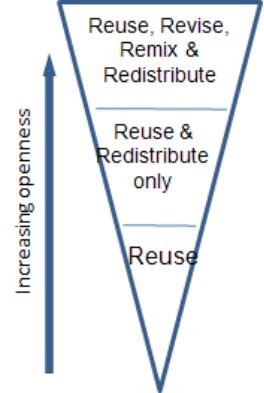
The degree of openness in terms of sharing and re-using resources (or restrictions) are indicated by the symbols in the CC license chosen by the resource creator and indicated by the symbols BY (attribution), SA (share-alike), NC (non-commercial) and ND (no derivatives).
Important aspects to note from UCT’s IP policy:
UCT automatically assigns to the author(s) the copyright, unless UCT has assigned ownership to a third party in terms of a research contract which includes:
Course materials, with the provision that UCT retains a perpetual, royalty-free, nonexclusive licence to use, copy and adapt such materials within UCT for the purposes of teaching and or research
Scholarly and literary publications, such as paintings, sculptures, drawings, graphics and photographs, produced as an art form
Recordings of musical performances and musical compositions
For more information, go to the RCIPS website.
For more information or to arrange a consultation regarding OER, contact:
EdTech Manager; Department of Health Sciences Education, Health Sciences Faculty