
Research: Impact of a change in infant BCG vaccination policy on adolescent TB incidence rates: A South African population-level cohort study

Professor Mark Hatherill, SATVI Director has co-authored a research paper titled “The impact of a change in infant BCG vaccination policy on adolescent TB incidence rates: A South African population-level cohort study” appearing in the Vaccine journal.
South Africa's infant Bacille Calmette Guerin (BCG) vaccine policy changed from percutaneous (PC) BCG Japan to intradermal (ID) BCG Denmark in 2000. This study investigated whether this change in infant BCG vaccination had any durable impact on TB incidence rates (IR) into adolescence.
This study took place in the Cape Town Metropolitan Area, South Africa. The 2011 census estimated a population of 3.7 million people.[23] Individuals who develop TB in Cape Town are reported to the TB control program, where treatment is provided free of charge. The primary diagnostic tool to diagnose TB changed throughout the course of this study. Prior to 2013 sputum smear microscopy was used primarily, occasionally with mycobacterial culture, after which sputum GeneXpert© assay was introduced.[24]
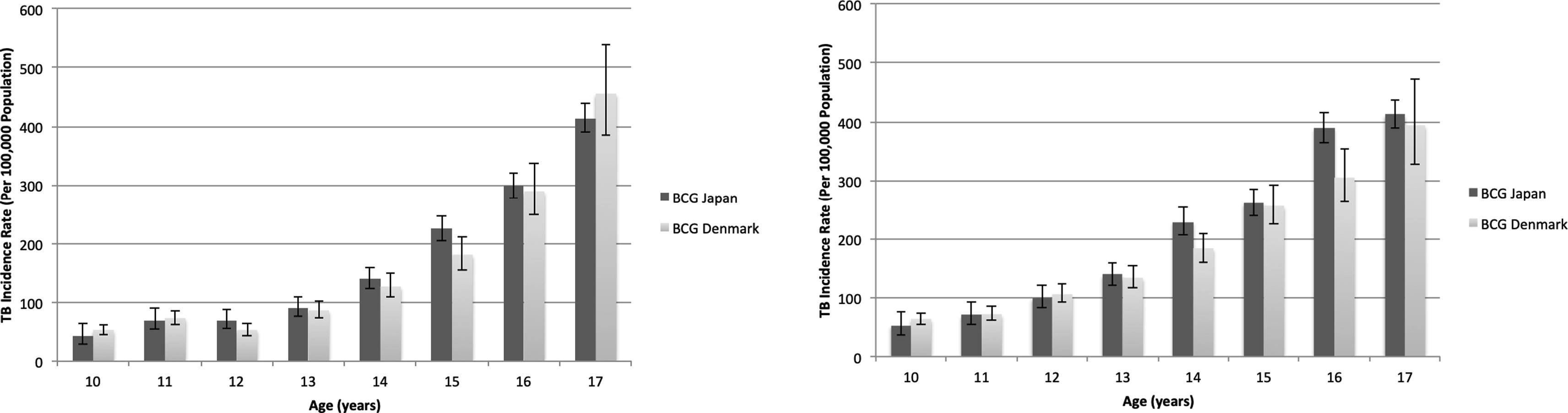
Birth cohort analysis showed there were no differences in TB incidence between the two BCG cohorts, with the exception of 16-year-old females where TB incidence was lower in the BCG Denmark cohort (Fig. 3). In both BCG cohorts TB incidence started to increase from 11 years onwards in females, whereas this increase occurred approximately 1 year later in males.
TB IR increased throughout adolescence, with 17-year-olds having 7.34 [95% confidence interval (CI), 6.48-8.32] times higher TB IR than 10-year-olds. Females had 1.22 [95% CI 1.17-1.27] higher IR than males. Overall, adolescents who received ID BCG Denmark had a lower TB IR compared to PC BCG Japan (rate ratio 0.86, [95% CI 0.80-0.94]). No interaction between BCG and age, nor BCG and gender were identified. Birth cohort analyses showed the increase in TB IR started around one year earlier in females than in males.
The study found change in infant BCG policy was associated with a modest decrease in TB incidence in 10- to 17-year-old HIV-negative adolescents. However, TB incidence rapidly increased with age in both adolescent cohorts and remained high despite BCG vaccination at birth.