
Expansion of Host Regulatory T Cells by Secreted Products of the Tapeworm Echinococcus multilocularis

Justin Komguep Nono of the Division of Immunology authored a paper entitled “Expansion of Host Regulatory T Cells by Secreted Products of the Tapeworm Echinococcus multilocularis” published on 8 May 2020 in Frontiers Immunology.
Alveolar echinococcosis (AE) is caused by the metacestode larval stage of the fox-tapeworm Echinococcus multilocularis. This chronic zoonosis is associated with significant modulation of the host immune response. Regulatory T-cells (Treg) are involved in an immunosuppressive environment around the metacestode during chronic disease however the molecular mechanisms of Treg induction by E. multilocularis and the parasite immunoregulatory factors involved are still unknown.
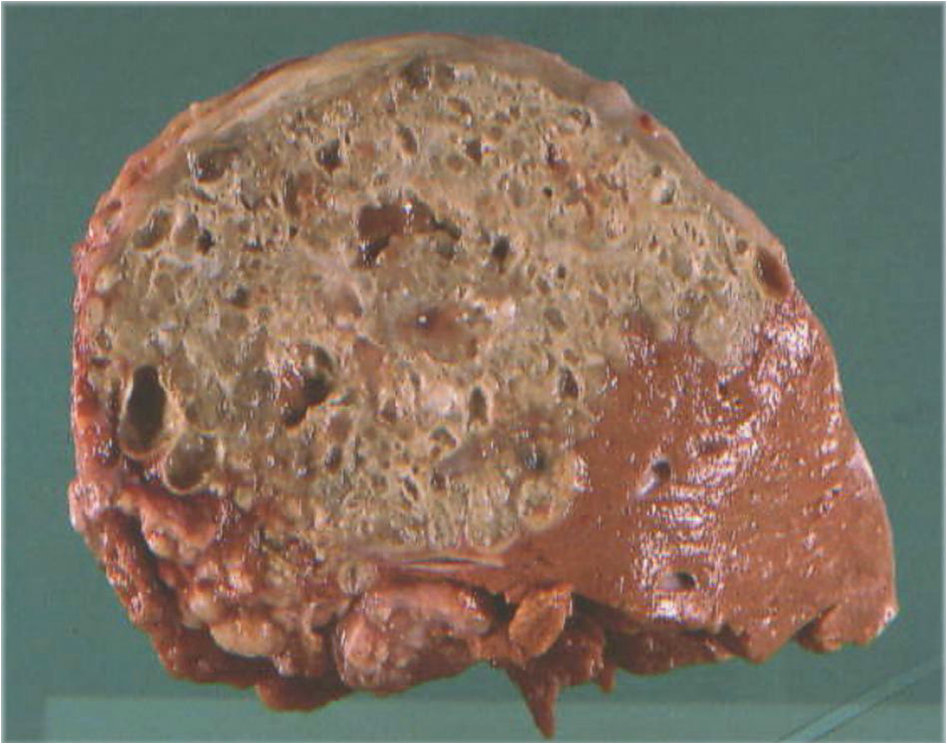
Human Liver infested with Echinococcus larvae
Dr Justin Komguep Nono and his collaborators from the University of Würzburg in Germany; parasitologist Professor Klaus Brehm and the Immunologist Professor Manfred Lutz in their paper “demonstrate that excretory/secretory (E/S) products of the E. multilocularis metacestode promote the formation of Foxp3C Treg from CD4C T-cells in vitro in a TGF-b-dependent manner, given that this effect was abrogated by treatment with antibody to mammalian TGF-b”.
The researchers also “show that host T-cells secrete elevated levels of the immunosuppressive cytokine IL-10 in response to metacestode E/S products. Within the E/S fraction of the metacestode we identified an E. multilocularis activin A homolog (EmACT) that displays significant similarities to mammalian Transforming Growth Factor-b (TGF-b/activin subfamily members. EmACT obtained from heterologous expression failed to directly induce Treg expansion from naïve T cells but required addition of recombinant host TGF-b to promote CD4C Foxp3C Treg conversion in vitro”.
Furthermore, “like in the case of metacestode E/S products, EmACT-treated CD4C T-cells secreted higher levels of IL-10. These observations suggest a contribution of EmACT to in vitro expansion of Foxp3C Treg by the E. multilocularis metacestode”. Using infection experiments Dr Komguep Nono and his collaborators show that “intraperitoneally injected metacestode tissue expands host Foxp3C Treg, confirming the expansion of this cell type in vivo during parasite establishment”.
The paper demonstrates that “E. multilocularis larvae secrete factors that induce the secretion of IL-10 by T-cells and contribute to the expansion of TGF-b-driven Foxp3C Treg, a cell type that has been reported crucial for generating a tolerogenic environment to support parasite establishment and proliferation”. Among the E/S factors of the parasite the researchers identified a factor with structural and functional homologies to mammalian activin A which might play an important role in these activities.
Read the paper - Expansion of Host Regulatory T Cells by Secreted Products of the Tapeworm Echinococcus multiloculari
Article by Bonamy Holtak