
The CNDU Journal Club provides nurses working with children with an accessible way of reading journal articles relevant to their practice.
Facilitating a journal club has been a core part of the work of the Children's Nursing Development Unit for many years. Beginning as a part of the nursing in-service programme at Red Cross War Memorial Children’s Hospital, the participative model used has proved to make research methodology and findings accessible to all cadres of nurses and facilitate application to current nursing practice.
In 2021, the model was applied to launch Journal Club to a wider online platform. Initially, an enrolled group of 17 teams across 8 African countries received guidance and materials developed to facilitate them to run a monthly in-person journal club in their clinical setting.
In 2024, using the same facilitation model, we have re-launched again, publishing our monthly journal club on our CNDU YouTube channel. This has widened the reach of journal club even further and increased access for individuals and not just teams. Details of the article each month, and links to the YouTube channel are posted below and on our social media (Facebook, LinkedIn) accounts.
What is a nursing journal club?
It is a planned gathering to review and discuss published research articles and provides a foundation for evidence-based nursing practice. Journal club participation has been found to be positively associated with increased familiarity with research terms and processes, increased habits of scientific reading and professional updating, and application of findings to practice.
This CNDU journal club uses a variety of innovative facilitation techniques with the goal of achieving:
- Increased access to journal articles
- Increased understanding of article content including research concepts
- Increased knowledge of the most recent evidence base.
- Facilitated application of knowledge of recent evidence to practice
The journal club covers a range of topics relevant to clinical and education practice, with a new article released each month. Monthly resources including a narrated summary video of the article, digital access to the journal article and a set of reflective questions.
The resources are posted each month below, and on our social media accounts. Click on the links to access them and then either watch and reflect alone or gathered a group of colleagues to engage together! Either way, please LIKE our journal club on YouTube and let us know what you learnt from and most enjoyed about the article by commenting on Facebook or YouTube 😊
Past Journal Club resources are also available below increasing your access to research further!
If you would like to more formally start an in-person Journal Club in your practice setting, make use of the following guide, ‘How to Run a Journal Club’.
Working with mothers to care for hospitalised children (SA)
This journal club is about Distinctive nursing practices in working with mothers to care for hospitalised children. The article is titled Distinctive nursing practices in working with mothers to care for hospitalised children at a district hospital in KwaZulu-Natal, South Africa: a descriptive observational study’. and was published in the journal, BMC 2020.
Here are the Journal Club resources:
Click on the links; watch the video and/or read the article and then reflect using the questions below:
1. How does your current facility support or hinder mothers' continuous presence with hospitalised children?
2. What policies, resources, or attitudes create barriers, and what enables family involvement?
3. Think about a recent situation where you worked with a mother caring for her hospitalised child. Did you view her as someone who needed your permission and instruction, or as a capable partner with deep knowledge of her child?
4. What would it take in your setting to move from "tolerating" family presence to deliberately "facilitating" it?
This journal club is about children with respiratory failure. The article is titled ‘Effect of comprehensive nursing intervention in children with respiratory failure: A retrospective comparative study’ and was published in the journal, American Journal of Translational Research in 2022.
Here are the Journal Club resources:
Click on the links; watch the video and/or read the article and then reflect using the questions below:
- How do retrospective design and convenience sampling impact study validity?
- What scalability challenges exist for comprehensive nursing in diverse paediatric settings?
- Which SF-36 domains improved most, indicating the holistic impact of comprehensive nursing?
- What do you understand to be the greatest difference between conventional nursing care and comprehensive nursing care?
Closed
This journal club is about sleep promotion for children. The article is titled, ‘Sleep promotion for hospitalised children: Developing an evidence-based guideline for nurses’ and was published in the journal, Curationis, in 2021.
Here are the Journal Club resources:
Click on the links; watch the video and/or read the article and then reflect using the questions below:
- Has this article made you think differently about children’s sleep or lack thereof in hospital?
- In what way do you think this guideline could be applicable to your clinical setting?
- Is there an aspect of sleep promotion that you think you could improve on?
- Consider what is required to implement this guideline and share how you would go about it with the rest of the group.
Closed
This journal club is about burns in children under 5. The article is titled, ‘Prevalence, risk factors and perceptions of caregivers on burns among children under 5 years in Kisenyi slum, Kampala, Uganda’ and was published in the journal, Epidemiol, in 2022.
Here are the Journal Club resources:
Click on the links; watch the video and/or read the article and then reflect using the questions below:
- What did you learn from this article?
- Were you surprised at the prevalence and frequency of different types of burns reported in this article? Consider the reason for your answer.
- Do you think that you would find similar results in similar location near your hospital/clinic?
- What does this make you think about the health education needs of caregivers in your clinical setting?
Closed
This journal club is about paediatric preoperative fasting times at Red Cross War Memorial Children's Hospital. The article is titled, ‘A prospective study of paediatric preoperative fasting times at Red Cross War Memorial Children's Hospital, Cape Town, South Africa’ and was published in the journal, South African Medical Journal, in 2022.
Here are the Journal Club resources:
Click on the links; watch the video and/or read the article and then reflect using the questions below:
- What did you learn from this article?
- What are the current fasting practices in your unit?
- What barriers might you face in implementing changes?
- How can you advocate for evidence-based policies?
Closed
This journal club is about adolescent and young adult HIV clinics in Ghana. The article is titled, ‘What happens at adolescent and young adult HIV clinics? A national survey of models of care, transition and disclosure practices in Kenya’ and was published in the journal, Tropical Medicine & International Health, in 2020.
Here are the Journal Club resources:
Click on the links; watch the video and/or read the article and then reflect using the questions below:
- What did you learn from this article?
- How do services in your facility compare?
- What innovative approaches could you implement in AYA services in your setting?
- How can you improve disclosure practices?
- What do you think the role is for nursing in transition protocol
Closed
This journal club is about the experiences of mothers and significant others in accessing care in the first 1000 days during COVID-19. The article is titled, ‘Experiences of mothers and significant others in accessing comprehensive healthcare in the first 1000 days of life post-conception during COVID-19 in rural Uganda’ and was published in the journal, BMC Pregnancy and Childbirth, in 2022.
Here are the Journal Club resources:
Click on the links; watch the video and/or read the article and then reflect using the questions below:
- What was the one “take- away” message you got from this article?
- Have the results of this article made you think differently about your current practice?
- Is there an aspect of care that you think you could improve and how would you go about initiating this?
Closed
This journal club is about the quality of life in children with tracheostomies. The article is titled, ‘The assessment of quality of life in children with tracheostomies and their families in a low to middle income country (LMIC)’ and was published in the journal, International Journal of Pediatric Otorhinolaryngology, in 2020.
Here are the Journal Club resources:
Click on the links; watch the video and/or read the article and then reflect using the questions below:
- What was the one “take- away” message you got from this article?
- Have the results of this article made you think differently about your current practice?
- Is there an aspect of care that you think you could improve and how would you go about initiating this?
Closed
This journal club is about the impact of basic life support training in Rwanda. The article is titled, ‘ Impact of structured basic life-support course on nurses' cardiopulmonary resuscitation knowledge and skills: Experience of a paediatric department in low-resource country’ and was published in the journal, African Journal of Emergency Medicine, in 2021.
Here are the Journal Club resources:
Click on the links; watch the video and/or read the article and then reflect using the questions below:
- What did you learn from this article?
- If you conducted this study in your clinical setting, do you think the results would be similar?
- How has this article made you think differently about your current practice?
- Make a list of benefits your team may experience from regular updates and BLS training.
Closed
This journal club is about the challenges nurses in Ghana experience when caring for children with cancer. The article is titled, ‘A qualitative study of Ghanaian pediatric oncology nurses’ care practice challenges’ and was published in the journal, BMC Nursing, in 2021.
Here are the Journal Club resources:
Click on the links; watch the video and/or read the article and then reflect using the questions below:
- What did you learn from this article?
- If you conducted this study in your clinical setting (tailoring the interview questions to your speciality), do you think the results would be similar?
- Identify ONE of the administrative challenges that is also present in your clinical setting, and consider how you and your team currently manage it.
- Thinking about the personal constraints, identify TWO ways in which you could overcome, or at least address them.
Closed
This journal club is about Continuous Positive Airway Pressure (CPAP) perspectives in Malawi. The article is titled, ‘Barriers and enablers of implementing bubble Continuous Positive Airway Pressure (CPAP): Perspectives of health professionals in Malawi.’ and was published in the journal, PloS one, in 2020.
Here are the Journal Club resources:
· Graphic
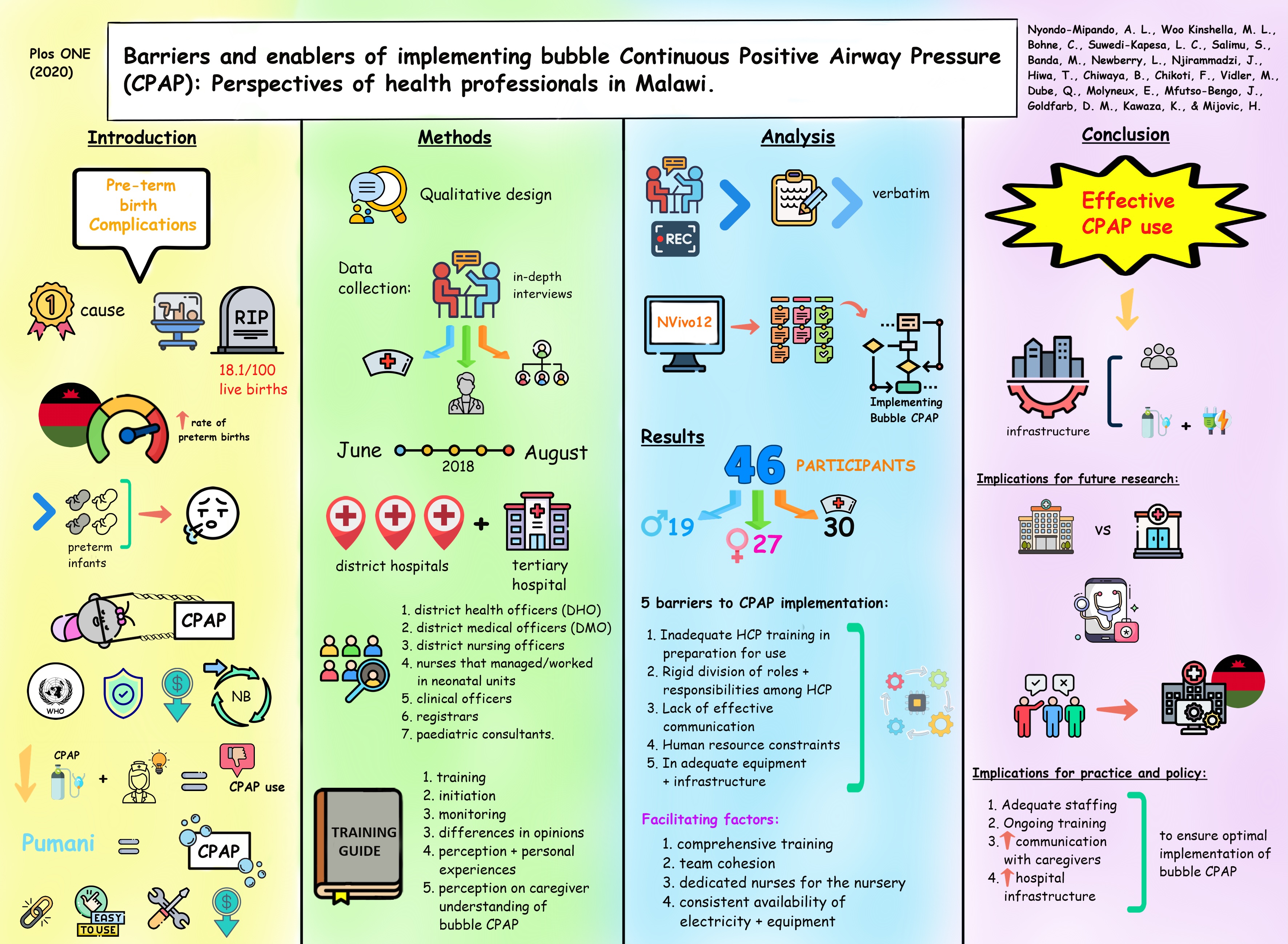
Click on the links; watch the video and/or read the article and then reflect using the questions below:
- On page 4 of the article under “Interviews” the authors describe who the interviewers were. What were the qualifications/areas of expertise of the interviewers?
- On page 5 of the article, under “Results” the authors summarise the average length service of the HCP that participated in the interviews – eight years. What was the average number of years’ experience in using CPAP?
- On page 11, paragraph 3, of the article under “Discussion”, the authors compare the results of this study to a study conducted in India. In the Indian study, CPAP was accepted by HCP – what two factors impeded its implementation?
Closed
Harris, N., Amos, A., & North, N. (2021). Role of the nurses in partnering with mothers to give oral medication to their hospitalised child: Modification and development of a contextualised evidence-based practice guideline. curationis, 44(1), 2224. https://doi.org/10.4102/curationis.v44i1.2224
• Narrated Graphic Summary Video
• Digital copy of the ejournal article
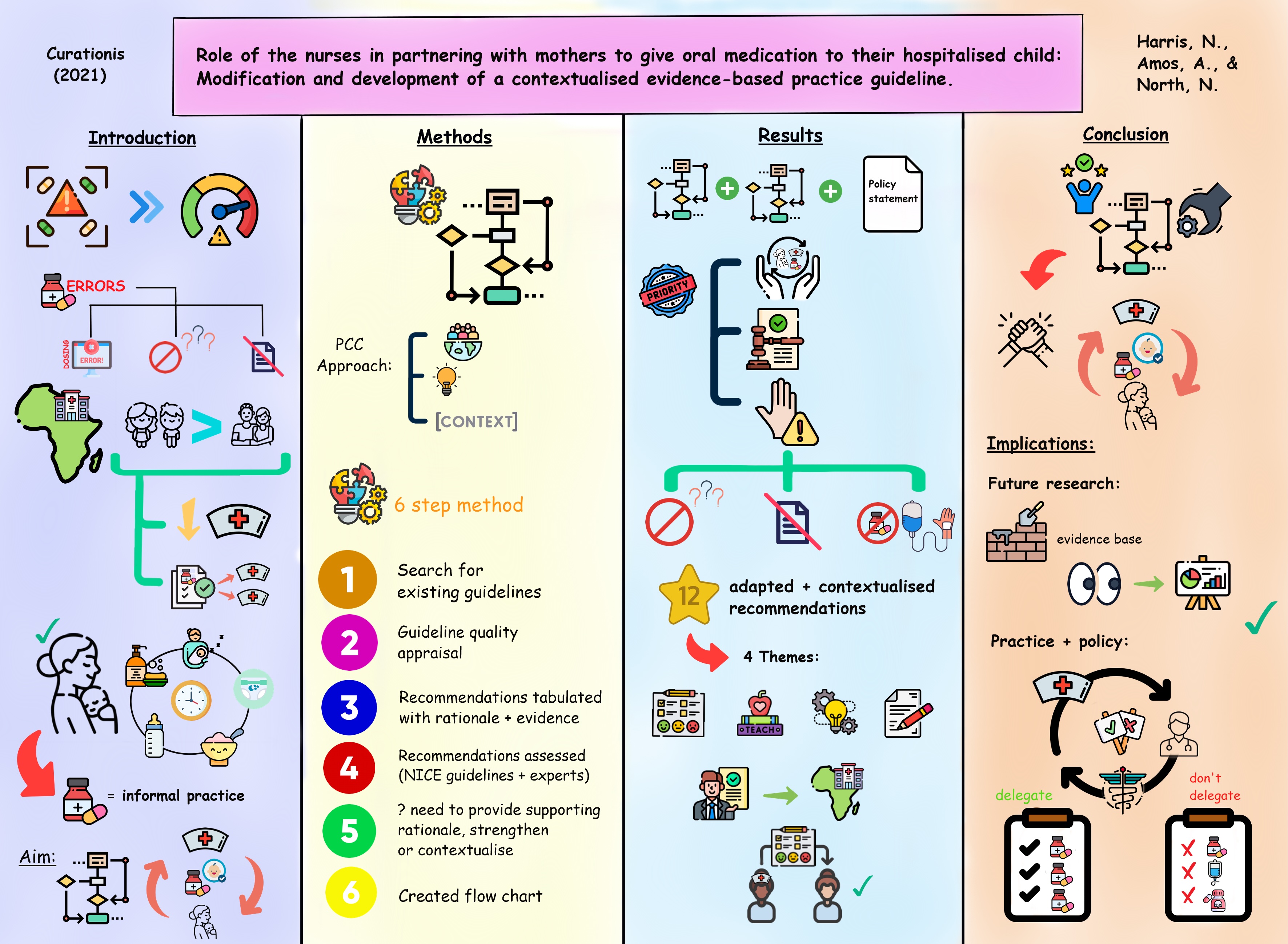
• Reflective questions:
- On page 6 of this article in the table of recommendations, the authors explain what would happen if the mother/caregiver was not considered competent to participate in oral administration of medication. What do they recommend in this instance?
- On page 7 under the “Implementation” recommendations, who do the authors recommend as responsible for observing the patient for adverse reactions?
- The flow chart on page 8 summarises the recommendations; what are the four main points that the nurse must educate the mother/caregiver on?
- If medication errors are one of the most frequent causes of adverse events in the hospital setting, is this something that nurses can or should be involving mother with?
Closed
Hussain, A. S., Ahmed, A. M., Arbab, S., Ariff, S., Ali, R., Demas, S., ... & Farooqi, J. (2021). CLABSI reduction using evidence based interventions and nurse empowerment: a quality improvement initiative from a tertiary care NICU in Pakistan. Archives of Disease in Childhood, 106(4), 394-400. https://doi.org/10.1136/archdischild-2019-318779
• Narrated Graphic Summary video
• Digital copy of the journal article
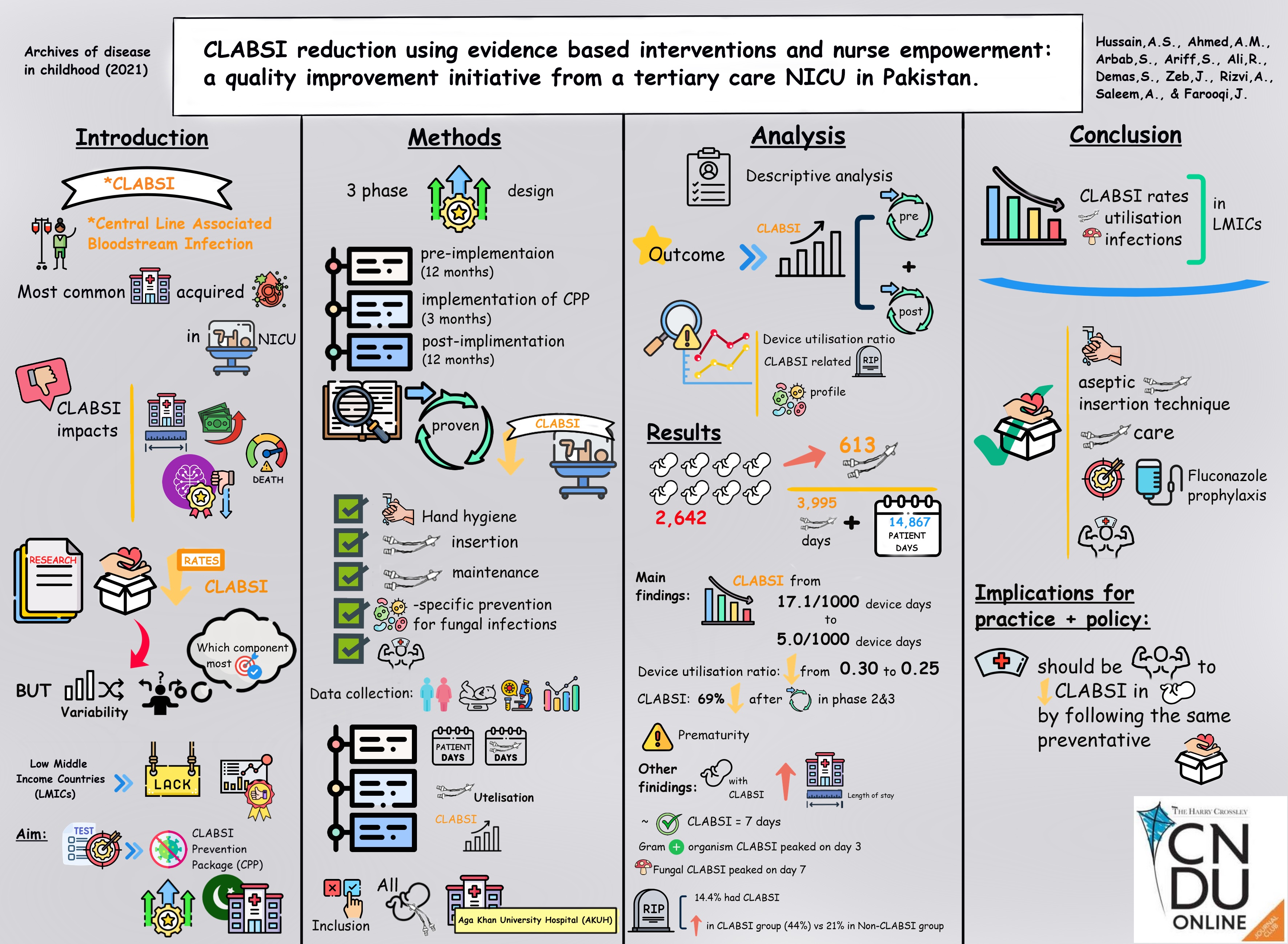
• Reflective questions for this month:
- On page 2, under context, how do the staff at AKUH routinely prevent infection in newborns?
- On page 3, in the first paragraph, how do the authors define CLABSI?
- Table 1 on page 2 of the article details the five components of the CLABSI Prevention Package. Under point 3, central line maintenance, discuss why the “stamp” was used.
- In Table 1, under central line insertion, what were the maximal barrier precautions used?
- Look at Table 2 on page 4: How many neonates in total were ≤ 27 weeks gestation?
Closed
Bian, W., Cheng, J., Dong, Y., Xue, Y., Zhang, Q., Zheng, Q., ... & Yang, H. (2023). Experience of pediatric nurses in nursing dying children-a qualitative study. BMC nursing, 22(1), 126. https://doi.org/10.1186/s12912-023-01274-0
• Narrated Graphic Summary video
• Digital copy of the journal article
• Static graphic
• Reflective questions for this month:
- On page 3 of this article, under ‘Ethical considerations’, how did the authors assure anonymity of the participants? What happened to the audio recordings at the end of the study?
- On page 4 of the article, under ‘Data collection’, what interview skills training did the investigators receive?
- In the ‘Results’ of the article (pages 4 to 6), the authors provide the main topics identified and sub-themes for each. Under the sub-themes, find one example of the nurse’s exact words for each.
- What do you find stressful about caring for a dying child?
- What do you find helpful in dealing with your emotions related to the dying or deceased child?
- What do you think the results would be if this study is conducted in your setting?
Closed
Chasweka, G., Majamanda, M. D., & Namathanga, A. (2023). The Cry to Be Involved: Experiences of Caregivers on Participation in Decision Making and Care Provision at Mercy James PICU in Blantyre, Malawi. Comprehensive child and adolescent nursing, 46(1), 20-32. https://doi.org/10.1080/24694193.2022.2085821
• Narrated Graphic Summary video
• Digital copy of the journal article
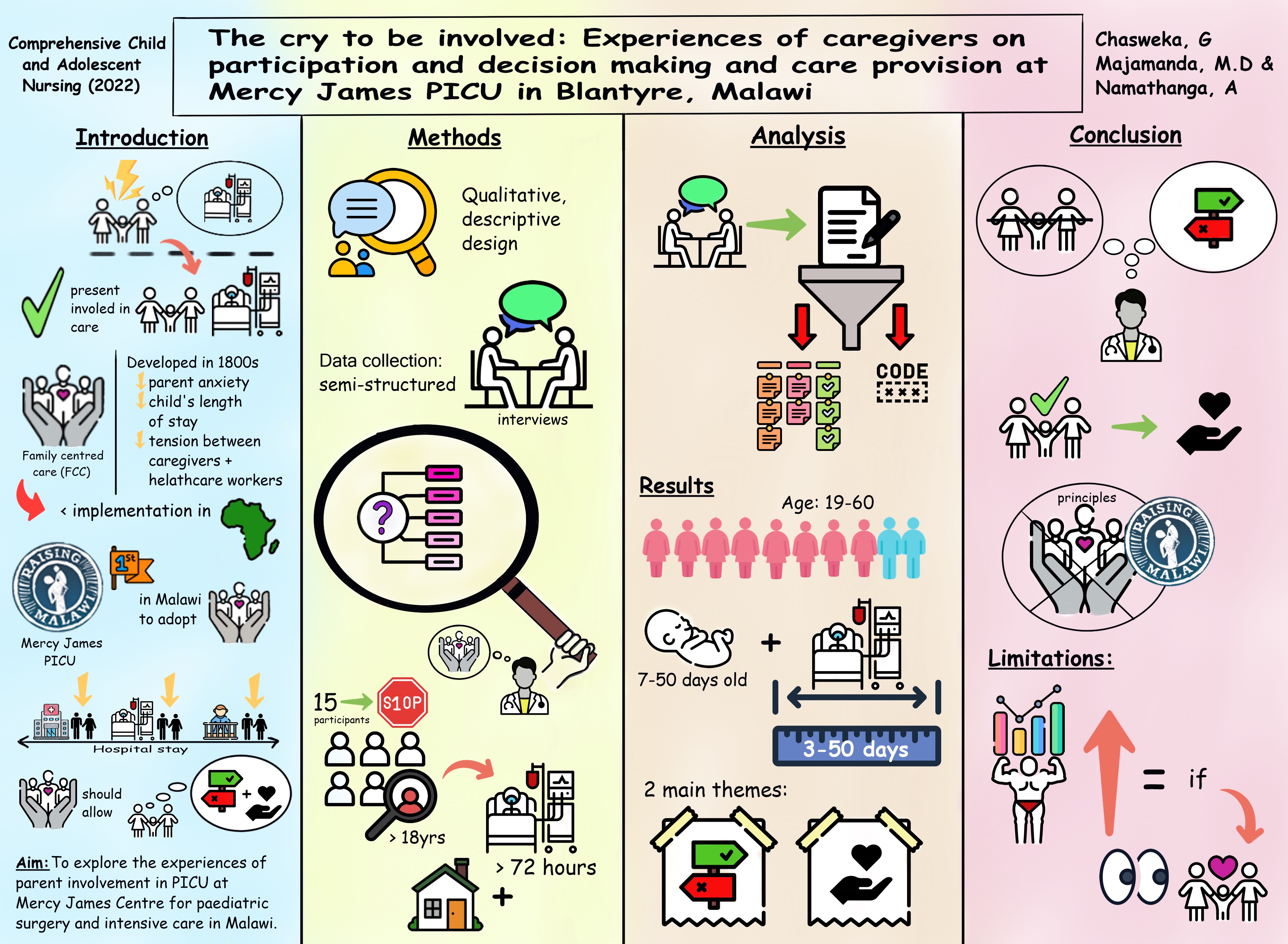
• Reflective questions for this month:
- On page 4 of this article, in paragraph 1, what areas of FCC did the probe questions address?
- On page 4 under “ethical considerations”, how was the participants’ privacy ensured?
- On page 5 under “participants”, what were the reasons for the children’s admission to PICU?
- On page 6, what was the main reason given by caregivers for them not being involved in ward rounds?
- On page 7, what example was given by the caregiver for how the healthcare workers had provided support to him/her?
Closed
Balliram, R., Sibanda, W., & Essack, S. Y. (2021). The knowledge, attitudes and practices of doctors, pharmacists and nurses on antimicrobials, antimicrobial resistance and antimicrobial stewardship in South Africa. Southern African Journal of Infectious Diseases, 36(1), 262. https://doi.org/10.4102/sajid.v36i1.262
• Narrated Graphic Summary video
• Digital copy of the journal article
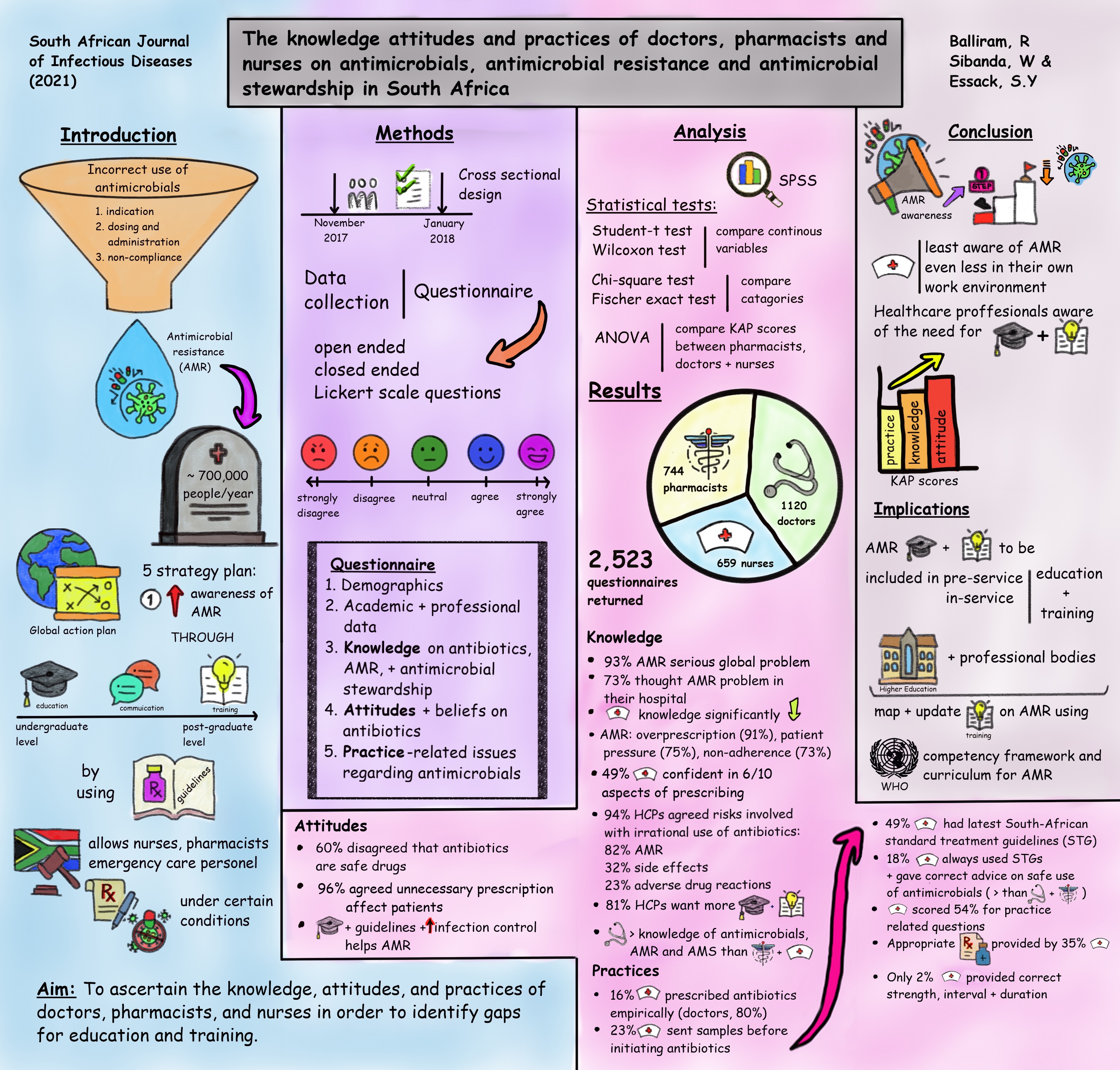
• Reflective questions for this month:
- On page 2 of this article, the authors mention 5 interventions that would increase awareness of AMR. Which intervention addresses an audience other than HCP?
- Also on page 2, under ‘Methods’, the authors explain how participants were identified. What two organisations were used to identify participants and distribute the questionnaires?
- On page 5, in paragraph 2, column 1: what were the preferred sources of information on the appropriate use of antimicrobials? In paragraph 3, column 2 on page 5, which group of HCP (doctors, pharmacists or nurses) represented the highest percentage that thought skipping a does would contribute to AMR?
- Under the heading ‘Practices’ on page 5, column 2, the authors detail how many pharmacists and nurses were licensed to prescribe antimicrobials. On page 6 (paragraph 1, column 1), how many pharmacists and nurses in this study prescribed antimicrobials without a license?
Closed
Gashaye, M., Tilahun, D., Belay, A., & Bereka, B. (2023). Perceived utilization of leadership styles among nurses. Risk management and healthcare policy, 215-224. https://doi.org/10.2147/RMHP.S388966
• Narrated Graphic Summary video
• Digital copy of the journal article
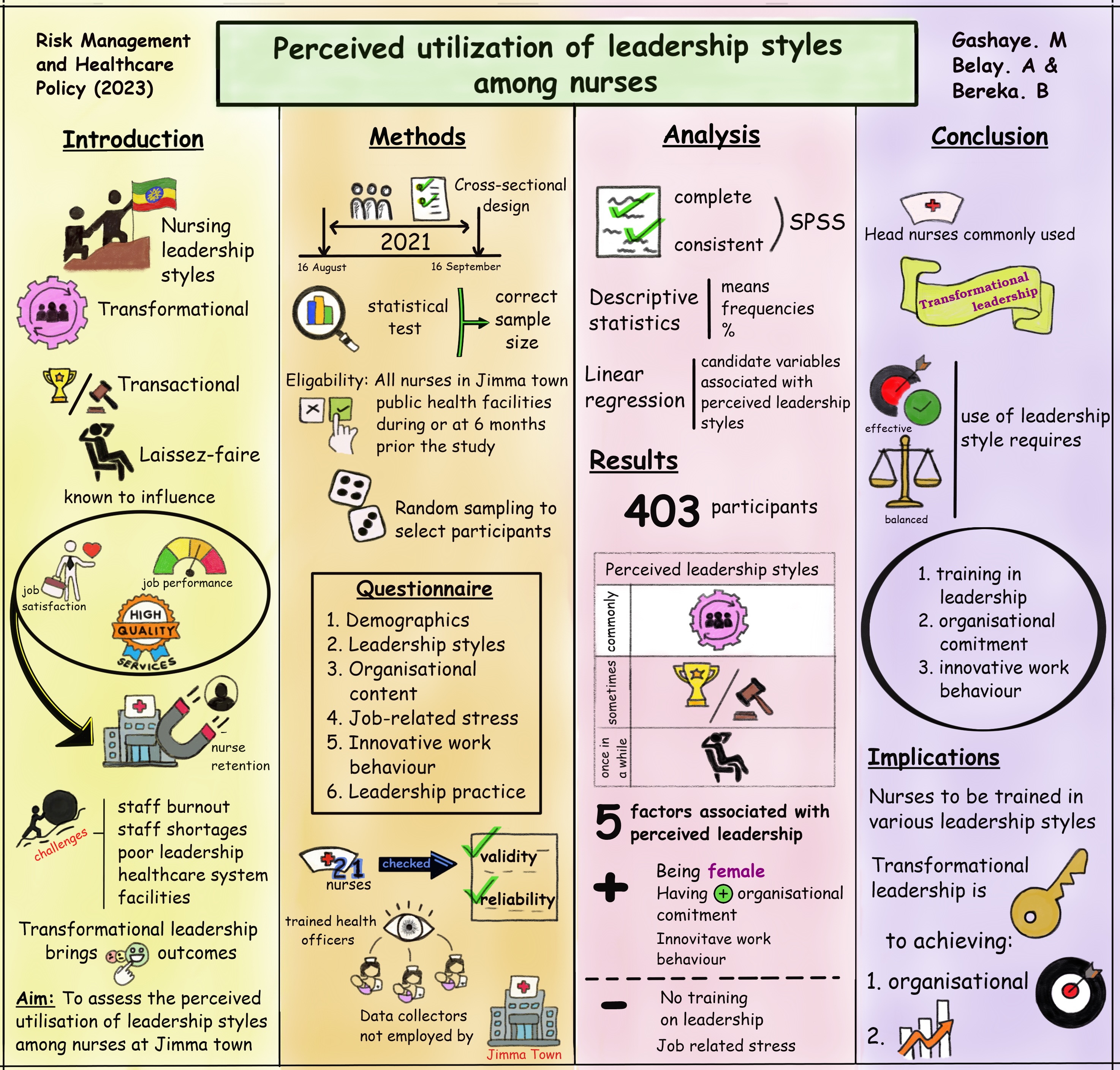
• Reflective questions for this month:
- Which is the biggest age range of nurses who participated in the study?
- What level of qualification was most common?
- How many nurses had received training in leadership?
- On page 6 of this article, under ‘factors associated with perceived use of leadership style among staff nurses’, the authors describe the process of finding the five factors that were associated with perceived leadership. How many factors did they start with?
Closed
Van Der Heijden, M. J., de Jong, A., Rode, H., Martinez, R., & van Dijk, M. (2018). Assessing and addressing the problem of pain and distress during wound care procedures in paediatric patients with burns. Burns, 44(1), 175-182. https://doi.org/10.1016/j.burns.2017.07.004
• Narrated Graphic Summary video
• Digital copy of the journal article
• Reflective questions for this month:
1) On page 2 of this article, in column 2, the researchers describe what children were not eligible. Why do you think children were excluded if they had a hearing impairment of altered level of consciousness?
2) On page 3 of the article, under ‘Procedure’ the authors describe standard wound dressing care. Are the parents routinely allowed to be with the child? How do you feel about the answer? Should parents be present or not?
3) In the top right column on page 6 of the article, the authors discuss parental anxiety, depression, and guilt as a result of their child’s burn injury. How do they suggest this relates to their child’s distress and what do they recommend?
4) Figure 2 on page 6 illustrates the mean (average) COMFORT-B scores in children < 3 years and >3 years. Hopefully you have a better understanding of boxplots now and can answer which age-group had the wider range of scores (between highest and lowest)? Which age group had three children that had COMFORT-B scores outside of the reported range?
Closed
McCulloch, M. I., Nourse, P., & Argent, A. C. (2020). Use of locally prepared peritoneal dialysis (PD) fluid for acute PD in children and infants in Africa. Peritoneal Dialysis International, 40(5), 441-445 https://doi.org/10.1177/0896860820920132
• Narrated Graphic Summary video
• Digital copy of the journal article
• Reflective questions for this month:
1) On page 2, column 2 of this article: Were antibiotics given at the insertion of peritoneal dialysis catheters?
2) On page 2, under “Results”: Discuss the ages of children treated. How many children were < 1 year old and how many were > 1yr old? What was the median weight?
3) On page 3 in Table 2: What was the greatest indication for peritoneal dialysis ? And what was the greatest underlying diagnosis?
4) On page 3, column 2, under point 4: What possible reason do the authors give for only two patients having peritonitis?
Closed
Naidoo, D., Gurayah, T., Kharva, N., Stott, T., Trend, S. J., Mamane, T., & Mtolo, S. (2016). Having a child with cancer: African mothers' perspective. South African Journal of Occupational Therapy, 46(3), 49-54. https://doi.org/10.17159/2310-3833/2016/v46n3a9
• Narrated Graphic Summary video
• Digital copy of the journal article
• Reflective questions for this month:
1) The findings are reported on page 2 and 3 of this article. Find a mother’s quote that shows her feelings of guilt and anxiety.
2) As above, find a mother’s quote on page 3 that provides an example of a mother’s coping mechanism.
3) On page 3, a mother who was given the name “Eunice” expresses her distress over her oldest child at home – what is her distress about?
4) On page 5 of this article, the authors describe “ubuntu”. How do they relate this value to the mothers’ occupational roles at home?
5) Look at figure 1 on page 5 and read the paragraph below it. Discuss what the shift in the mothers’ responsibilities does to the family’s occupations.
Closed