For Practitioners
Resources and guidelines for practitioners on community engagement, covering guiding principles, ethics, participatory methods, evaluation frameworks, training, toolkits, and case studies to support health research.

Public engagement and community engagement are often used interchangeably, but public engagement is a broader term for involving the public in dialogue and decision-making on common issues, while community engagement is a more specific, collaborative process that focuses on working directly with a local community to address issues that affect its well-being. Both involve two-way communication to foster a sense of shared ownership and lead to better, more sustainable outcomes, though the terms can have different meanings depending on the context.
“Public engagement, just like science, can be messy and head in unexpected directions. That cannot, and must not, be a reason not to do it: science has a duty to respond to the views of the public it seeks to serve and represent. And done properly, public engagement can give research more impact and relevance.”
2018. How to get public engagement right. Nature 555, 413–414.
Community engagement and involvement is understood to mean
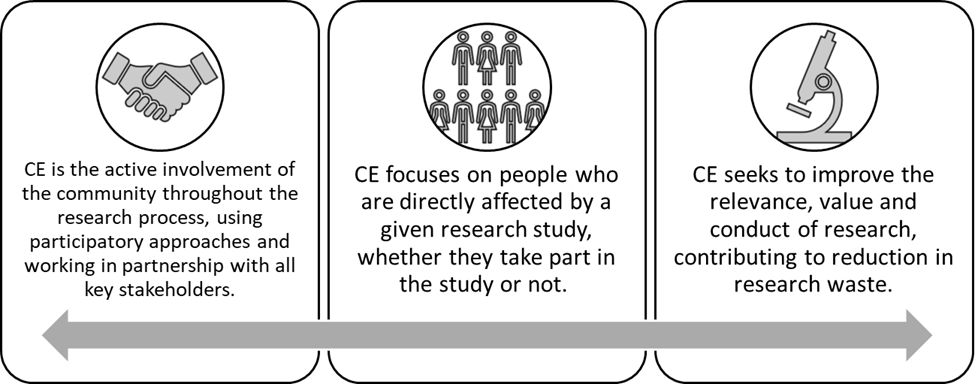
In the context of engagement, “community” has been understood in two ways. It is sometimes used to refer to those who are affected by the health issues being addressed. This use recognizes that the community as defined in this way has historically been left out of health improvement efforts even though it is supposed to be the beneficiary of those efforts. On the other hand, “community” can be used in a more general way, illustrated by referring to stakeholders such as academics, public health professionals, and policy makers as communities. This use has the advantage of recognizing that every group has its own particular culture and norms and that anyone can take the lead in engagement efforts. It is important to identify your target community within every research endeavor and place them at the center.
CEI stands for community engagement and involvement - the active involvement of communities throughout the global health research process.
The National Institute for Health and Care Research (NIHR) has outlined seven guiding principles for global health research. The principles provide guidance for the research community in developing, delivering, and evaluating CEI. They can help ensure that planned activities are robust, appropriate, and effective for the local context, research topic, and design. The principles can also be helpful as criteria to assess research proposals. These principles are not a set of rules, but a values-based tool. They are non-hierarchical and non-linear guiding principles, designed to be flexible and motivational and can be operationalized in many ways.
Planning for CEI requires input from communities at early stages of research to ensure it aligns with local values and needs. CEI should take into consideration the type and aims of the research, local knowledge, and context. This can be achieved through collaboration and partnerships with community members and organisations to ensure wider representation, including the most vulnerable and marginalised.
Working with communities to identify priorities and to develop mechanisms for continued collaborations throughout research planning, delivery, and dissemination. This enables a sense of joint ownership, adds value, increases the relevance, reach, and impact of the research. It is important to note that the level of involvement may vary at different stages of the research lifecycle and according to the type or nature of research.
Communities are not homogenous. They can consist of people with different interests, histories, social structures, values, and cultural customs. Learning about the community and the variations within it is an important element of knowing which CEI approaches will be appropriate within a research context. Researchers should respect the different forms of knowledge and experience that influence the way people learn and engage.
Taking time to actively listen, respect, and understand the perspectives of communities and research collaborations helps to build strong relationships, and enable community partnerships to thrive. It is necessary to develop mechanisms for two-way communication and feedback that are ethical, sustainable, and mutually beneficial.
Regularly assessing and addressing evolving power dynamics ensures that power‑sharing practices remain relevant and effective in promoting equitable CEI. Identifying opportunities to facilitate working together will enable community members to speak freely, without fear of being intimidated.
There is no "one size fits all" approach to CEI because every community and context is unique and responds to changing circumstances differently. Embedding critically reflective practices and trying different approaches in response to community feedback will ensure that research remains focused on local needs.
Plans should be developed for recording and evaluating CEI processes and outcomes against the research objectives to understand their impact; these can be both positive and negative. This process helps to determine what works and enables changes to be made. Involving community members in monitoring, evaluation, and learning activities from the beginning will help to produce indicators and measures that are mutually valuable.
“Community engagement is grounded in the principles of community organization: fairness, justice, empowerment, participation, and self-determination.”
2011. Clinical and translational science awards consortium community engagement key function committee task force on the principles of community engagement
Community engagement is about relationships between and among communities, researchers, and research institutions. Community engagement creates opportunities to improve the consent process, identify ethical pitfalls, and create processes for resolving ethical problems when they arise. The Yale University Clinical and Translational Science Award (CTSA) Committee on Ethical Principles of Engagement developed an expanded set of ethical guidelines specifically for community-engaged research in 2009. The Committee expanded upon traditional biomedical ethics of the Belmont Report (Respect for Persons, Beneficence, and Justice) to focus on the relationships between researchers and community partners, emphasizing that ethical review should not just protect individual research subjects but also govern the interactions and power dynamics between research partners (academic institutions and community organizations).
The committee identified several key areas for ethical practice:
All partners receive equal respect.
Communities and investigators share power and responsibility equitably.
Protect communities in research.
Protect communities in research.
Communities and investigators share power and responsibility equitably.
This section presents some theory and foundational approaches to public and community engagement.
<4h> Community Engagement Continuum
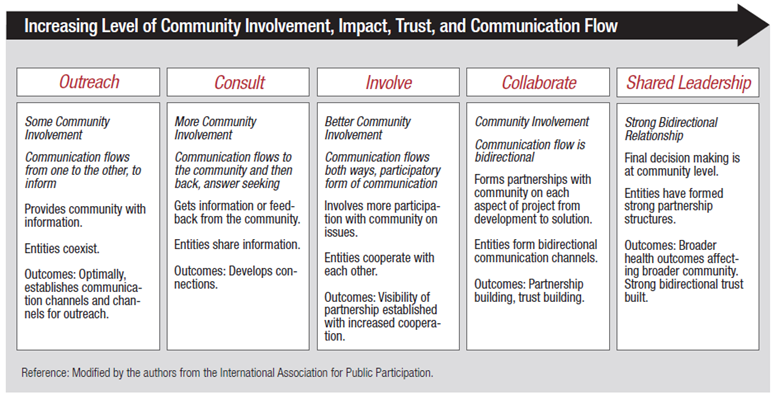
Community engagement can be seen as a continuum of community involvement. The Figure below, modified from a diagram originally drawn by the International Association for Public Participation, illustrates one way of thinking about such a continuum. The IAP2’s Spectrum of Public Participation was designed to assist with the selection of the level of participation that defines the public’s role in any public participation process. Over time, a specific collaboration is likely to move along this continuum toward greater community involvement, and any given collaboration is likely to evolve in other ways, too.
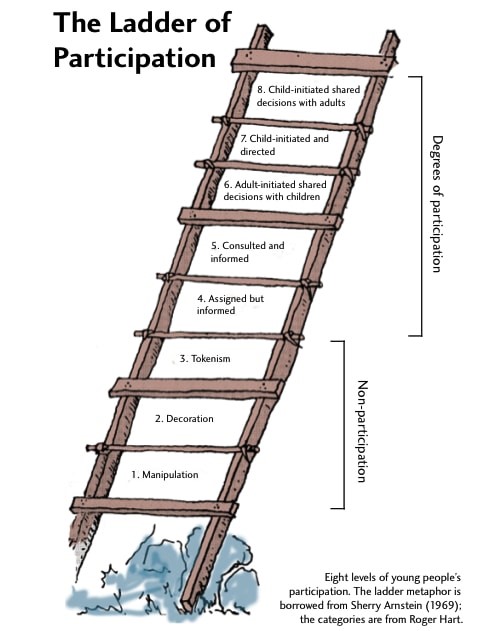
Another useful tool was famously outlined by Sherry Arnstein in 1969. This is a model showing levels of community involvement in decision-making, ranging from non-participation (manipulation, therapy), through tokenism (informing, consultation, placation), to genuine citizen power (partnership, delegated power, citizen control), aiming to illustrate where real influence lies and encouraging movement towards shared power for meaningful engagement. In his essay for UNICEF, Children’s Participation: From Tokenism to Citizenship, Hart (1992) adapted Arnstein’s Ladder of Citizen Participation (1969, p.217) “to serve as a beginning typology for thinking about children’s participation in projects” (p.9).
Participatory methodologies can play a crucial role in increasing adherence, participation, and engagement of people toward a common goal. In health actions, these methodologies are especially powerful, as they encourage active collaboration between health professionals and the community, ensuring that activities are more relevant, accessible, and meaningful to the populations involved.
Evaluation and impact in community engagement focuses on assessing how well engagement processes work (process evaluation) and the real-world changes they create (outcome/impact evaluation) to ensure effectiveness, accountability, learning, and meaningful community influence. This means moving beyond just proving success to understanding transformations in people, systems, and outcomes, using tools like logic models and focusing on collaboration, equity, and feedback loops.
Two approaches are particularly useful when framing CE evaluation; both engage the involved stakeholders. The first one emphasizes the importance of participation; while the second focuses on empowerment.
The first approach, participatory evaluation, actively engages the community in all stages of the evaluation process. The second approach, empowerment evaluation, helps to equip program personnel with the necessary skills to conduct their own evaluation and ensure that the program runs effectively.
Participatory evaluation can help improve program performance by:
Characteristics of participatory evaluation include:
Empowerment evaluation is an approach to help ensure program success by providing stakeholders with tools and skills to evaluate their program and ensuring that the evaluation is part of the planning and management of the program.The major goal of empowerment evaluation is to transfer evaluation activities from an external evaluator to the stakeholders.
Empowerment evaluation has four steps:
Characteristics of empowerment evaluation include the following:
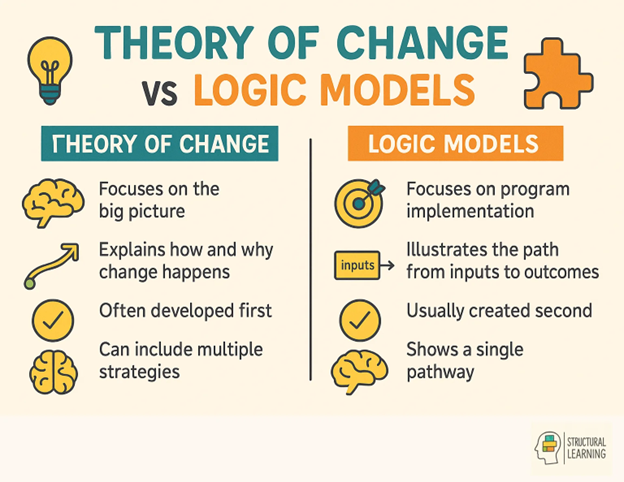
Several frameworks are available for evaluating community impact, each offering unique approaches to understanding and measuring outcomes. The most used frameworks include the Logic Model and the Theory of Change, which help organizations articulate their goals and assess their effectiveness in achieving them.
The Logic Model framework provides a visual representation of the relationship between resources, activities, outputs, and outcomes. It helps organizations clarify their goals and the steps needed to achieve them, making it easier to track progress and evaluate success.
Key components of a Logic Model include inputs (resources), activities (program actions), outputs (direct products), and outcomes (short-term and long-term effects). For example, a community health initiative might list funding and staff as inputs, health workshops as activities, the number of participants as outputs, and improved health metrics as outcomes.
When using a Logic Model, ensure that each component is clearly defined and logically connected. Common pitfalls include vague definitions and overlooking the importance of measuring both outputs and outcomes. Regularly revisiting and updating the model can enhance its effectiveness.
The Theory of Change model outlines the necessary preconditions, pathways, and interventions required to achieve desired outcomes. It emphasizes the importance of understanding the context and assumptions behind a program’s strategy, making it a comprehensive tool for impact assessment.
This model typically begins with a clear definition of the long-term goal, followed by the identification of intermediate outcomes and the specific activities that will lead to those outcomes. For instance, a program aimed at reducing youth unemployment might identify skills training as an activity, with increased job placements as an intermediate outcome. To effectively implement a Theory of Change, engage stakeholders in the development process to ensure buy-in and relevance. Avoid assumptions without evidence and regularly review the theory to adapt to changing circumstances or new insights. This iterative approach can significantly enhance the model’s accuracy and applicability.
Resource: An interactive template developed by the Global Schools Forum in collaboration with Better Purpose.
The evaluation of community engagement may need both qualitative and quantitative methods because of the diversity of issues addressed.
An evaluation can use quantitative or qualitative data and often includes mixed methods. Both methods provide important information for evaluation, and both can improve community engagement.
Qualitative assessment methods focus on gathering in-depth insights through interviews, focus groups, and open-ended surveys. These approaches allow for a nuanced understanding of community experiences and perceptions regarding specific initiatives.To implement qualitative assessments, consider conducting regular community meetings or workshops where participants can share their thoughts and feelings. This can help identify strengths and weaknesses in programs and highlight areas for improvement.
Quantitative metrics involve numerical data that can be statistically analyzed to measure community impact. Common metrics include participation rates, demographic changes, and economic indicators such as income levels or employment rates. When selecting quantitative metrics, ensure they align with the goals of your community initiatives.
Community engagement evaluation may need both qualitative and quantitative methods due to the diversity of issues addressed (e.g. population, type of project, and goals). The choice of methods should fit the need for the evaluation, its timeline, and available resources.
Stakeholder feedback is crucial for understanding the effectiveness of community programs. Engaging with community members, local businesses, and organizations can provide valuable perspectives on how initiatives are perceived and their actual impact
To gather feedback, consider using structured surveys or informal discussions. Regularly reviewing this feedback can help adjust programs to better meet community needs and enhance overall effectiveness.
Case studies analysis involves examining specific instances of community initiatives to draw lessons and insights. By analyzing successful and unsuccessful programs, organizations can identify best practices and common pitfalls.
When conducting case studies, focus on diverse examples from similar communities to understand different contexts and outcomes. This comparative analysis can inform future strategies and improve the likelihood of success in new initiatives.
NIHR Three critical considerations for community engagement and involvement
NIHR Community Engagement and Involvement Impact Showcase - 25 November 2025