Genetic Counselling
Discover COIN's genetic counselling work: bridging genomic research and patient care through culturally appropriate support and family-centred guidance.

Genetic counselling is the process of helping individuals and families understand and adapt to the medical, psychological and familial implications of genetic contributions to disease. Within the Clinical Omics and Informatics Unit (COIN), it plays a central role in offering genomic testing and delivering results to patients with neurological disorders.
Neurological disorders often have a complex genetic basis. Many families experience long diagnostic odysseys. Genomic testing has the potential to provide clarity, but only when results are communicated meaningfully. The genetic counselling process guides patients and families through complex genomic information, from pre-test education and consent to post-test interpretation and emotional support. These findings are contextualized and translated into accessible language, explaining how specific gene variants can cause, contribute to, or modify disease presentation and what it means to the patient and their family.
Genetic counselling ensures that testing is both scientifically sound and ethically grounded. It bridges the gap between genomic testing strategies and the lived experience of the patient, fostering understanding, balancing uncertainty and hope. It supports informed decision-making in an environment where scientific discovery and patient care meet. By embedding genetic counselling into genomic testing, COIN ensures that each diagnostic journey is supported by compassion, clarity and context.
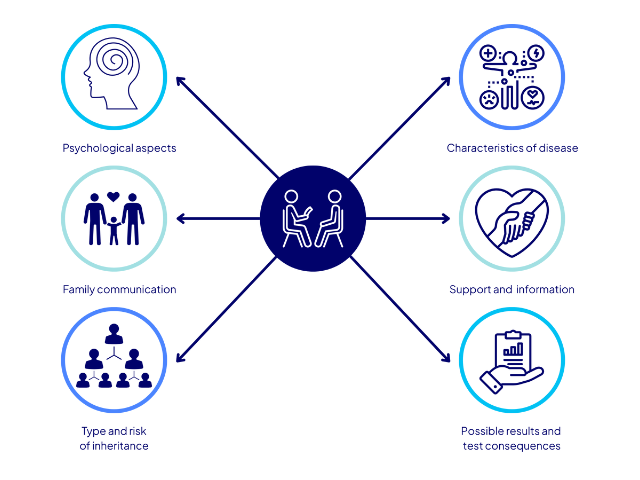
We connect genetic counselling, variant curation and data sharing, forming an integrated framework where laboratory findings are accurately interpreted, ethically communicated and shared responsibly.
Globally, the value of genetic counselling is well established; it supports diagnosis, communication and psychological adjustment. However, in many African contexts, access to trained genetic counsellors and local genomic data remains limited.
Existing counselling models, developed in high-income countries, do not always reflect African languages, belief systems, or health infrastructures. There is a growing need to develop contextually grounded approaches that address these realities and align with regional ethical and social frameworks.
Through genetic counselling, we aim to provide contextually appropriate pre- and post-test counselling for patients and families undergoing genomic testing for neurological disorders, ensuring that complex results are explained clearly and compassionately. We work to strengthen ethical and informed consent processes, helping participants understand not just what testing involves, but how their data may be used responsibly. Finally, we’re committed to building local capacity and leadership in genetic counselling, so that expertise in genomics grows within our healthcare system.
Key challenges include the shortage of trained counsellors across Africa, the underrepresentation of African genomes in global databases, and the absence of context-specific counselling resources. COIN’s research integrates counselling from the start of every project, ensuring that ethical engagement, participant understanding and feedback mechanisms are built into the genomic testing pathway. The COIN team works collaboratively, linking genetic counsellors with neurologists, bioinformaticians and medical geneticists. Creating a holistic framework for patient-centred genomics.
Our research continues to evolve through listening; to patients, families and communities. By including their experiences and perspectives, we aim to ensure genomics in Africa is built with and for its people.