Ancestry Aware Research
Discover COIN's work with pangenomes: building comprehensive genomic references that represent African diversity and advance precision medicine on the continent.

Every person’s DNA carries a record of their ancestry; a genetic mosaic shaped by generations of migration, adaptation and population mixing. In Africa, this story is especially intricate. As the birthplace of all humankind, the continent holds the greatest genetic diversity on the planet. Yet, much of global genomics research has historically focused on non-African populations, leaving major gaps in how genetic data from Africans are interpreted.
Ancestry-aware research seeks to bridge that gap. Instead of assuming that genetic variation means the same thing across all populations, this approach considers how ancestry shapes the structure and interpretation of the genome. In other words, it recognises that the “genetic dictionary” used to read DNA differs across populations and that understanding those differences is crucial for accurate, equitable research and clinical care.
In South Africa, where people often have complex, multi-continental ancestries, ancestry-aware methods are particularly important. At the COIN Unit, we use genomic tools that identify both global ancestry (the overall proportions of a person’s ancestral backgrounds) and local ancestry (the origin of specific segments along the genome) (Figure 1). These insights allow researchers to better interpret genetic variants, understand disease patterns and avoid biases caused by Eurocentric reference data.
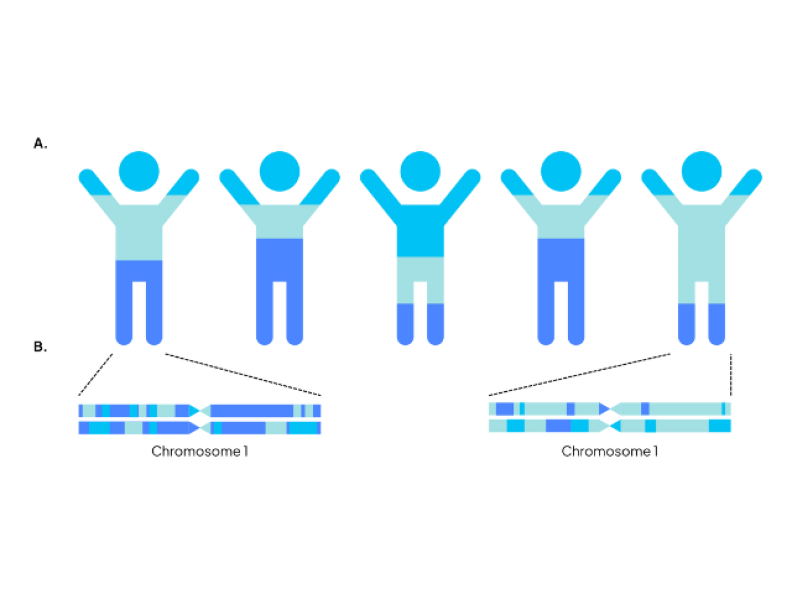
By anchoring our analyses in ancestry, we’re not only improving the accuracy of genetic findings, we’re also uncovering the unique stories written in African genomes.
Genomic medicine promises a future of precision healthcare, but that promise can only be fulfilled if the data we use truly represents all people. Without ancestry-aware approaches, many genomic findings risk being incomplete or misleading, especially in diverse African populations. Our work aims to change that. By integrating ancestry into every stage of analysis, COIN researchers can:
This research doesn’t just fill a knowledge gap it creates a foundation for genomic equity. It ensures that tools developed for interpreting genetic data are relevant to the people they are meant to serve.
In the African context, where populations have deep and complex ancestral histories, ancestry-aware research allows us to understand neurological and genetic disorders with far greater precision. It also contributes to a more inclusive global understanding of human diversity; one where Africa’s data informs, not just supplements, international science.
As ancestry inference tools become more sophisticated, the COIN Unit is working to integrate them into every level of our research, from variant discovery to disease interpretation. Future work will focus on refining local ancestry models, expanding African reference panels and embedding ancestry awareness into clinical genomics pipelines to build a truly inclusive foundation for precision medicine in Africa.
Publications to link to:
Kinghorn, 2025
Nel 2019, 2022
Mahungu, 2023