Congratulations to Drs Fulufhelo Masithulela and Hugo Krynauw
Fulufhelo Masithulela and Hugo Krynauw graduated both with a PhD in Cardiovascular Biomechanics during UCT's graduation ceremony on 13 June 2016.
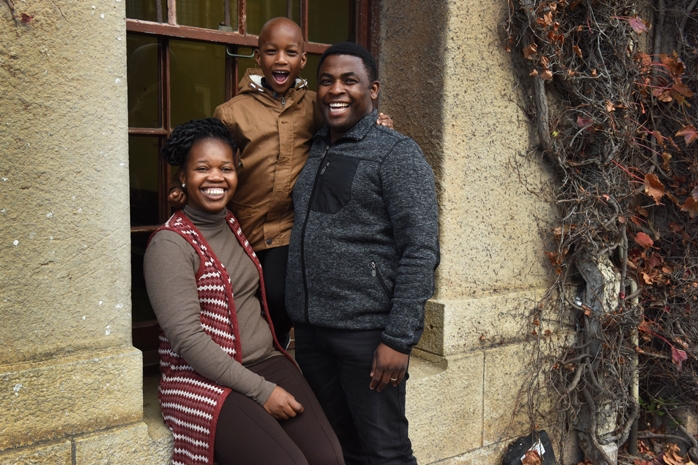
Fulufhelo Masithulela with his wife Muthumuni and his six-year-old son Mukhethwa.
Fulufhelo Masithulela obtained the PhD for a thesis titled & quot;Computational Biomechanics in the Remodelling Rat Heart Post Myocardial Infarction" that improves the understanding of the impairment of pump function and myocardial mechanics in the remodelling infarcted heart by employing subject-specific cardiac computational models..
Fulufhelo holds a BSc and MSc in Mechanical Engineering from the University of Witwatersrand. In 2011, he was appointed at UNISA and is a Senior Lecturer in the Department of Mechanical and Industrial Engineering. He recently set up a well-equipped biomechanics laboratory that is the only of its kind in Africa. Fulufhelo thesis is concerned with the study of impaired cardiac mechanics and function in the remodelling heart following myocardial infarction (MI). Ischemic heart disease including MI is a leading cause of death worldwide. There are no effective therapies for MI, the only treatment for heart failure following MI is heart transplantation. Imperative for the development of novel therapies is the understanding of the structural and functional changes in the infarcted heart undergoing adverse remodelling. By developing finite element models of the same heart at different stages after infarction from magnetic resonance images, Fulufhelo Masithulela captured changes of the remodelling heart. Employing these models for computational simulations of the cardiac cycle, i.e. filling and ejection, allowed the subject-specific comparison of impaired pump function of the left ventricle and altered mechanics, that is strain and stress, in the cardiac muscle throughout the left and right ventricles as the heart remodels.
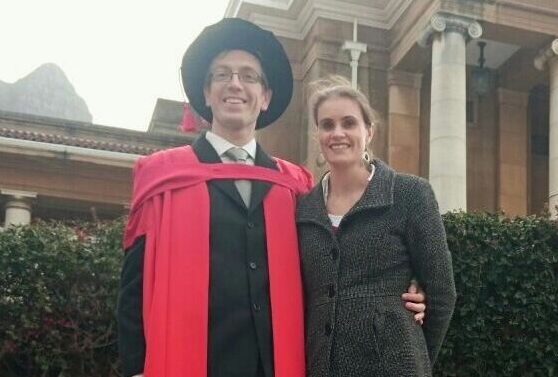
Hugo Krynauw with his wife Carolyn
Hugo Krynauw presented a thesis on "Tailoring of the Biomechanics of Tissue-regenerative Vascular Scaffolds" that investigates the mechanics of fast-degrading polyester-urethane scaffolds for therapeutic regeneration of soft biological tissues and demonstrates the potential of these scaffolds to improve the performance of current clinical implants in the context of coronary artery disease.
Hugo obtained a BSc (Eng) in Electro-mechanical Engineering in 2006 and an MSc (Med) in Biomedical Engineering in 2009, both from the University of Cape Town. His PhD thesis developed from his interest in the design of therapeutic devices for cardiovascular diseases. Hugo's thesis is concerned with the investigation of polymeric fibrous scaffolds for therapeutic regeneration of soft biological tissues. Biodegradable scaffolds aim at restoration a patient’s organ by gradual replacement of synthetic implant with the patient’s own newly formed tissue. To prevent premature failure of the regenerating implant, the rate of the degradation and associated loss of structural integrity of the scaffold needs to be well characterised and tuned to the rate at which new tissue is formed. Hugo Krynauw provides comprehensive data on the change of mechanical properties of fast-degrading polyester-urethane scaffolds when exposed to concurrent degradation and tissue ingrowth following implantation. He demonstrates that scaffolds allow to balance the mechanical effects of degradation and tissue development. He further demonstrates that the polyester-urethane scaffolds exceed current clinically used materials, such as PET and ePTFE, in the ability to mimic physiological mechanics of arteries in the context of coronary artery disease.