Art, Imagination, and Science: Reflections on Ralph Borland’s Residency at the EthicsLab and Neuroscience Institute
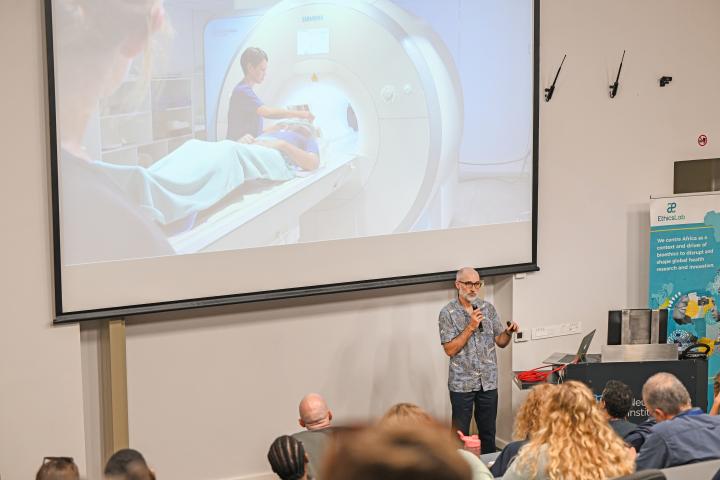
Dr Ralph Borland reflects on some of his most impressive art projects over the years.
Ralph Borland’s final lecture at the UCT Neuroscience Institute marked the close of a two-month artist residency with the EthicsLab. The lecture functioned as a reflective pause and an opportunity to think carefully about what it means to bring artistic practice into sustained conversation with science, ethics, and emerging technologies.
Over the course of the residency, Borland worked closely with researchers, clinicians, and students within the NI. His approach was not to “translate” science into art, nor to treat art as an illustrative add-on, but to use artistic inquiry as a way of noticing, questioning, and intervening in clinical environments where ethical questions are already being lived.
A practice shaped by intervention
Borland’s practice sits at the intersection of critical design and interventionist art. Beyond problem solving, critical design uses objects and scenarios to question taken-for-granted assumptions, surface relations of power, and invite reflection on how we live and might live otherwise. Similarly, interventionist art works directly within real social and institutional spaces, inserting actions or installations that interrupt everyday routines and make ethical issues newly perceptible. Borland’s work draws on both traditions, using material form to provoke reflection while also intervening in lived environments, shaping how people feel, move, and attend to the worlds they inhabit. He often describes his artworks as functional objects that communicate with audiences by inviting reflection, provoking discomfort, or making underlying systems visible.
In his lecture, Borland traced this lineage through earlier projects. His long-running collaborative project African Robots & SPACECRAFT, exhibited at Zeitz MOCAA and the Dakar Biennale, explores technology, labour, and imagination through speculative forms grounded in African contexts. Bone Flute, developed during a research fellowship at the Institute for Humanities in Africa (HUMA), involved the making of a playable flute from a 3D-printed replica of his own femur—a collaboration with an orthopaedic surgeon in a public hospital that brought together medicine, sound, embodiment, and care. Together, these projects—which have received wide public attention—set the tone for his residency at EthicsLab: art as a mode of inquiry that works with existing systems rather than outside them, and that treats technology not as neutral infrastructure but as something saturated with ethical meaning.
These projects set the tone for his residency at the EthicsLab, foregrounding art as a mode of inquiry that works with existing systems rather than outside them, and that treats technology not as neutral infrastructure but as something saturated with ethical meaning.
Art, ethics, and imagination
Borland’s residency unfolded alongside the EthicsLab’s AI and Imagination retreat, a three-day gathering (13-15 October) that explored the ethical questions raised by generative AI in creative expression. The retreat grappled with how generative AI is reshaping cultural production and unsettling long-standing ideas about originality, authorship, authenticity, and creative voice, and also how creatives might be understood as ethicists in their own right.
Borland’s residency was especially generative in the way it fed into a series of conversations and collaborative writing around AI’s impact on cultural production. Through different texts, we’ve been exploring how generative AI is changing not just what gets made, but the conditions under which imagination works. Creativity has always involved borrowing, imitation, and remix, and in that sense AI can look like a continuation of familiar cultural practices. But AI also introduces scale, speed, and automation in ways that are distinctive. When producing images, text, and music becomes easier than giving them time, care, and attention, and when voices, styles, and forms can be endlessly copied, something shifts. The question is no longer whether AI can be creative, but whether these systems support forms of creativity that are meaningful, sustaining, and attentive, or whether they push culture toward volume, repetition, and churn. In that sense, imagination itself becomes an ethical question.
Imaging imagination
One additional strand of Borland’s residency extended this inquiry into imagination through neuroimaging itself. Early in the residency, he was introduced to Dr Frances Robertson, a neuroimaging researcher at the Neuroscience Institute, and began exploring the possibility of placing himself in the scanner as part of his artistic process. Building on his earlier Bone Flute project—where internal anatomy was rendered visible outside the body—Borland became curious about what it might mean to make imagination visible, or at least traceable, through brain activity.
Working with Robertson, he developed a small experimental protocol in which he sculpted, drew, and visualised his proposed dichroic artwork while undergoing fMRI scanning at Groote Schuur Hospital. The resulting data were rendered as three-dimensional maps of brain activity across different creative tasks and control conditions, and contextualised against existing literature on visualisation. While further artistic work with this material is still ongoing, the project was never aimed solely at producing a definitive outcome. As with Bone Flute, its significance lay in the process: participating in clinical and research procedures, deepening collaboration with a medical researcher, and gaining embodied insight into the experiences of patients and clinicians who move through the Institute and hospital every day.
Light, space, and care
One of the most tangible outcomes of Borland’s residency is his proposal for a large-scale light-based installation in the Neuroscience Institute atrium. In his final lecture, he spoke about working with dichroic lenses—optical materials whose colour shifts with light, angle, movement, and time of day. He presented a small prototype (or maquette) using these lenses, allowing the audience to experience firsthand how light behaves in response to bodies moving through space.
What draws Borland to these materials is their instability. They never resolve into a single image, and no two encounters are the same. This quality is central to the work’s intent. Rather than presenting a fixed object to be interpreted, the installation comes into being relationally, through movement and changing conditions. In this way, it gently resists the emphasis on clarity, capture, and control that often shapes scientific and clinical environments.
The choice of site matters. The atrium is a shared, transitional space used by researchers, students, clinicians, and patients alike. At the base of the light well, patients and research participants often wait for scans, sometimes in moments of anxiety or uncertainty. The proposed installation offers a quiet sensory encounter that subtly alters the atmosphere of the space, meeting people where they are.
Here, ethics takes shape as something felt and spatial rather than abstract academic deliberation. Light, colour, and movement become ways of thinking about care—about how environments shape experience, invite attention, and matter in places where vulnerability is part of everyday life.
A model for future collaboration
Beyond a single artwork, Borland’s residency points toward a broader way of working between artists, scientists, and ethicists. In his lecture, he reflected on the value of being embedded in the everyday life of the Institute — spending time in shared spaces, in conversation, and in processes that unfold without predetermined outcomes. What often mattered, he suggests, was not arriving with a finished proposal, but allowing ideas to emerge through proximity, observation, and material experimentation.
This approach informs his thinking about a future artist-in-residence programme at the Neuroscience Institute. Rather than positioning artists as communicators or illustrators of scientific work, the residency model for which he is fundraising treats artistic practice as a form of inquiry in its own right — one that can surface ethical, social, and experiential questions that do not always register through conventional research practices.
Such a programme would create sustained opportunities for creative practitioners to work alongside scientists, not so much to resolve questions as to make them perceptible, to attend to atmosphere, space, and everyday experience, and to open new forms of dialogue within the institution. In this sense, the residency programme becomes a way of bridging scientific research and public life through imaginative, attentive, and ethically grounded engagement.
Closing reflections
Borland’s residency shows how artists can function as a critical resource within scientific institutions by slowing attention, working experimentally with uncertainty, and making the ethical dimensions of research environments perceptible in everyday experience. At a time when scientific and technological innovation is often driven by speed, efficiency, and optimisation, artistic practice offers a different kind of contribution— one that attends to atmosphere, embodiment, and the ways people actually inhabit research and clinical spaces. Rather than arriving with solutions, the artist’s role here is to notice, intervene, and open questions that might otherwise remain in the background.
The proposed light installation in the Neuroscience Institute atrium grows directly out of this approach. It is conceived as a subtle intervention into a shared space used by researchers, students, patients, families, and research participants —many of whom encounter the Institute in moments of waiting, vulnerability, or uncertainty. Supporting this work is therefore not only an investment in an artwork, but in a way of thinking about how scientific environments can be more attentive, reflective, and responsive to those who inhabit them.
If you would like to contribute to the Neuroscience Institute Creative Residency Programme, please contact Jacquie Bracher (j.bracher@uct.ac.za). This programme enables artists and scientists to collaborate, creating new insights, artworks and stories which explore the boundaries of Neuroscience.
Watch the presentation recording here