From suffering in silence to supporting in community
Addressing moral distress in healthcare providers at Groote Schuur Hospital.

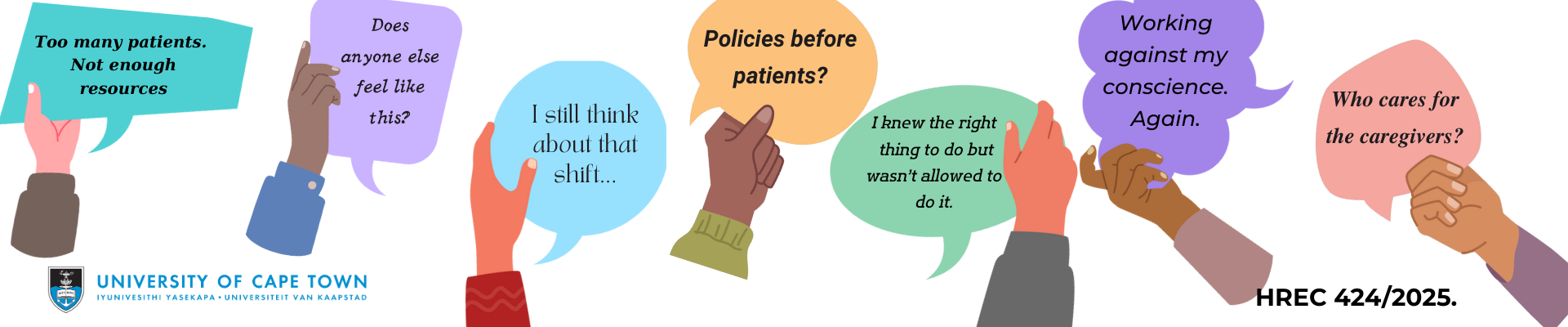
First introduced by a philosopher working with nurses (Jameton, 1984), the term ‘moral distress’ describes the occurrence when an individual’s moral agency is constrained, preventing them from acting in accordance with their ethical and professional values. In simpler terms, it is the experience of knowing the right course of action but feeling unable to take it due to external barriers. Healthcare professionals frequently encounter ethically challenging situations where institutional constraints, resource limitations, and hierarchical structures prevent them from acting according to their moral and professional judgement (Epstein and Delgado, 2010, Jameton, 1984).
In societies characterised by deep inequality and violence, such as South Africa, the healthcare environment itself is distressing. South Africa’s healthcare system is divided into two sectors: a public system serving the majority of the population and a private sector catering mainly to higher-income groups (Ramjee et al., 2013). Public healthcare is often overwhelmed by patient demand, resource shortages, and inadequate infrastructure, creating a difficult working environment for HCPs (Coetzee et al., 2013, Emmamally and Chiyangwa, 2020). High levels of poverty, unemployment, and violence create additional burdens for healthcare providers, as they are often placed in morally distressing situations without adequate support (Matisonn et al., 2023).
This research and intervention is a response to ever-increasing calls from healthcare practitioners to develop meaningful local mental wellbeing resources that clinicians will use. Drawing on a recognition of the role of community in supporting an individual’s wellbeing, our intervention signals a fundamental shift away from individualised support - where the pathology is placed on the healthcare providers themselves. Instead, we seek to build a community of practice in discussions about ethics. By combining ethics education with collegial peer support sessions in which difficult conversations can take place in a psychologically safe environment, we aim to provide and assess a unique and transformative experience for healthcare providers.
Funded by a 2024 Faculty of Health Sciences Stimulus Grant Award.