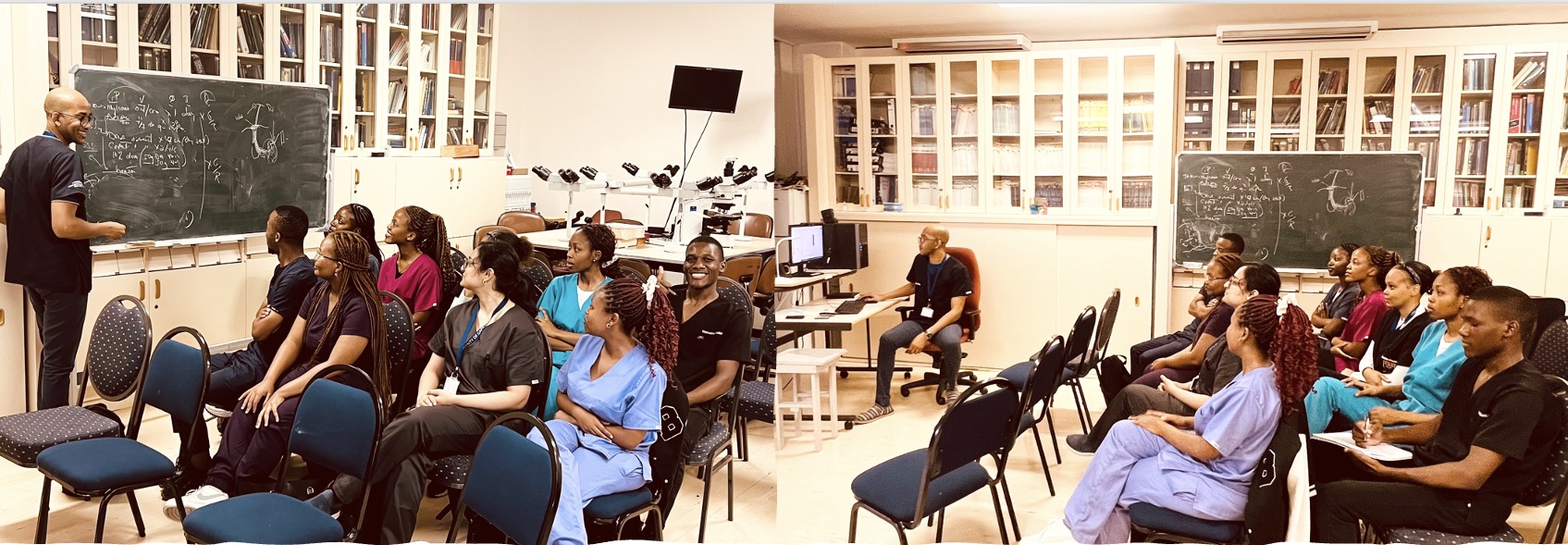
Undergraduate Training
Consultants and registrars are involved in lectures and tutorials for Undergraduate medical students in the 3rd, 4th and 5th years of the MBChB program, providing them with the skills necessary to run community clinics.
Postgraduate Training
Registrar Training Program
The dermatology training curriculum at the University of Cape Town is designed to provide broad and varied exposure to a wide range of clinical dermatology. Dermatology training in South Africa requires 4 years of full-time equivalent training. Registrar teaching takes place daily in the outpatient clinics and during inpatient consultations. There are four state-funded registrar training posts. We also have a cohort of supernumerary registrars and currently these are from South Africa, Botswana, Zimbabwe and Kenya. To register with the Health Professions Council of South Africa as a specialist dermatologist, a registrar must complete the following:
- Clinical training (which includes a portfolio of learning)
- Two fellowship examinations of the College of Dermatologists of South Africa (FCDermSA)
- Master of Medicine in Dermatology (which includes a research component).
Department and Training Locations
Hospitals:
-
Groote Schuur Hospital
This hospital is the largest tertiary care referral center in Cape Town and surrounding areas, accredited by the HPCSA as a University of Cape Town training facility for medical students, registrars, and fellows. It has 975 beds, including a 20-bed ward for complex inpatient dermatology care (18 for adults and 2 for children/adolescents). -
Red Cross War Memorial Children’s Hospital
This hospital is the largest paediatric tertiary care referral centre in Cape Town and surrounding area, accredited by the HPCSA as a University of Cape Town training facility for medical students, registrars, and fellows. The 300-bed hospital is a stand-alone tertiary hospital dedicated entirely to child healthcare. -
Mitchells Plein Community Health Centre
This is a primary healthcare centre that provides primary health services for free to the community of Mitchells Plain and surrounding areas. The nurse-driven dermatology clinic is supported by our dermatologists and registrars. - On-call services to the surrounding secondary hospitals and all primary healthcare centres via Vula mobile app.
Diplomas
NB: This Cosmetic Formulation Science Diploma is an NQL7 qualification. Thus, it is Postgraduate Program that is managed by the Undergraduate Admissions Office.
General information
The Advanced Diploma in Cosmetic Formulation Science is the first in South Africa and first to be located within a Division of Dermatology in the world. This is a deliberate choice that aims to reduce the divide between scientists who develop and dermatologists who treat the many adverse effects of cosmetic products. The teaching is a careful balance between solid cosmetic science knowledge and hands-on cosmetic industry experience (80% of the time). The Dermatology contribution to the program intends to sensitize students to deleterious health effects that cosmetic products can have on consumers.
Introduction
- 1-year full-time program
- Blended program with a 6-week block in January & 6-week block in June spent on campus at the Hair & Skin Research Lab, Observatory, Cape Town
- 6-month block at hosting cosmetic companies for practical hands-on experience between UCT blocks
- Cosmetic companies select students through an interview process during the first UCT block
- Students will be placed at companies anywhere in the country (subject to availability)
- Collaboration with the Services Sector Education and Training Authority (SSETA).
Aim
To produce graduates that are ready and equipped for product formulation in cosmetic manufacturing companies as: product developers, cosmetic formulators, R&D chemists or as entrepreneurs in the cosmetic industry.
Modules
(1) Scientific Principles of Cosmetic Formulations
(2) Cosmetic Formulation Technology
(3) Hair and Skin Biology for the Cosmetic Formulator
(4) Cosmetic: Claims, Regulations and Ethics
(5) Professional Communication and Project Management for Cosmetic Scientists
(6) In-service training
Admission requirements
To be considered for the programme, students must have obtained:
- BSc or equivalent with Chemistry 3
- or a degree with Biochemistry 3 (students with Biochemistry 3 need to have at least Chemistry 2 to be eligible for admission)
Offers in this program are made subject to availability of space.
All applicants should submit a CV and motivation letter with their application for the diploma.
National Benchmark Test (NBT): Not required.
Application process
For 2026 intake
All applications must be submitted online
Applications open 01 April 2025
Closing date for applications is 31 August 2025
1. Apply online using the link:
http://www.students.uct.ac.za/students/applications/apply/forms
2. Upload copies of your:
• National Senior Certificate.
• University academic record(s), degree certificate(s).
• Updated CV and a motivation letter explaining how the diploma will advance your career.
• Certified ID copy
3. If you have trouble uploading your documents, please forward to admissions-ug@uct.ac.za
4. You can upload additional documents on the student portal: https://studentsonline.uct.ac.za/psp/students/?cmd=login&languageCd=ENG&
5. Apply for residence accommodation using the link: http://housingonline.uct.ac.za
January – February block
16 January 2026 – 27 February 2026
Venue
Hair & Skin Research Lab, Room K47 51 Old Main Building, Groote Schuur Hospital, Observatory, 7925, Cape Town
Application queries
Queries with online submission: fhs-ug-admiss@uct.ac.za
Costs
Available on the UCT website: www.uct.ac.za
Financial Assistance
Postgraduate Funding office: www.pgfo.uct.ac.za
The University of Cape Town reserves the right to disqualify ineligible, incomplete and/or inappropriate applications.
More details on this diploma will be shared shortly.
Short Courses
This course is a 5-week course for Registered Medical Officers and Clinical Nurse Practitioners, covering the diagnosis, treatment and correct management of common skin conditions. It is offered by the Division of Dermatology to meet community driven demands for these dermatology services.
The programme starts with 1 week of face-to-face introductory tutorials and course work, followed by 3 weeks of online assignments to be completed while participants are in their workplace, supported by online contact with lecturing staff. The course ends with 1 week of face-to-face tutorials, revision and assessment.
This course does not provide access to registrar posts. NB: Internet access via a computer or smart phone with Wi-Fi is essential for the course.
Preference will be given to health practitioners working in primary care settings. It is expected that practitioners will return to their place of work during the course and much of the learning will be via support on a WhatsApp or UCT platform.
Course Content:
- Language of dermatology
- Diagnosis of common skin disorders
- Management of common skin conditions and promotion of skin health
- Recognition of life-threatening skin problems, requiring referral to specialist level of care
- Interim care of patients with life-threatening skin disorders, awaiting transfer to a higher level of care (e.g. drug reactions and erythroderma)
- Recognition of skin signs of serious systemic disorders such as HIV/AIDS, tuberculosis and diabetes
- Wound care
- Occupation-related skin disorders- management and referral
- Health Education and the application of topical treatment
- The impact of skin disorders on the individual, the family and the community
| Day | Time | Meeting |
|---|---|---|
| Monday: |
7:30am |
Journal Club |
| Tuesday: |
9:00-11:00am 2:00-3:00pm |
HSR Lab Teaching and Journal Club Histopathology Meeting |
| Wednesday: |
7:30am 8:00 - 09:00am |
Registrar Teaching Paediatric Meeting (at Red Cross Children’s Hospital) |
| Thursday: |
2:00-3:30pm 4:00-5:00pm |
Registrar Teaching Registrar Teaching |
| Friday: |
8:00-09:00am 12:00pm 12:30pm |
Registrar Teaching Paediatric case presentations (at Red Cross Children’s Hospital) Problem Adult Patient Clinic (last week of the month) |